
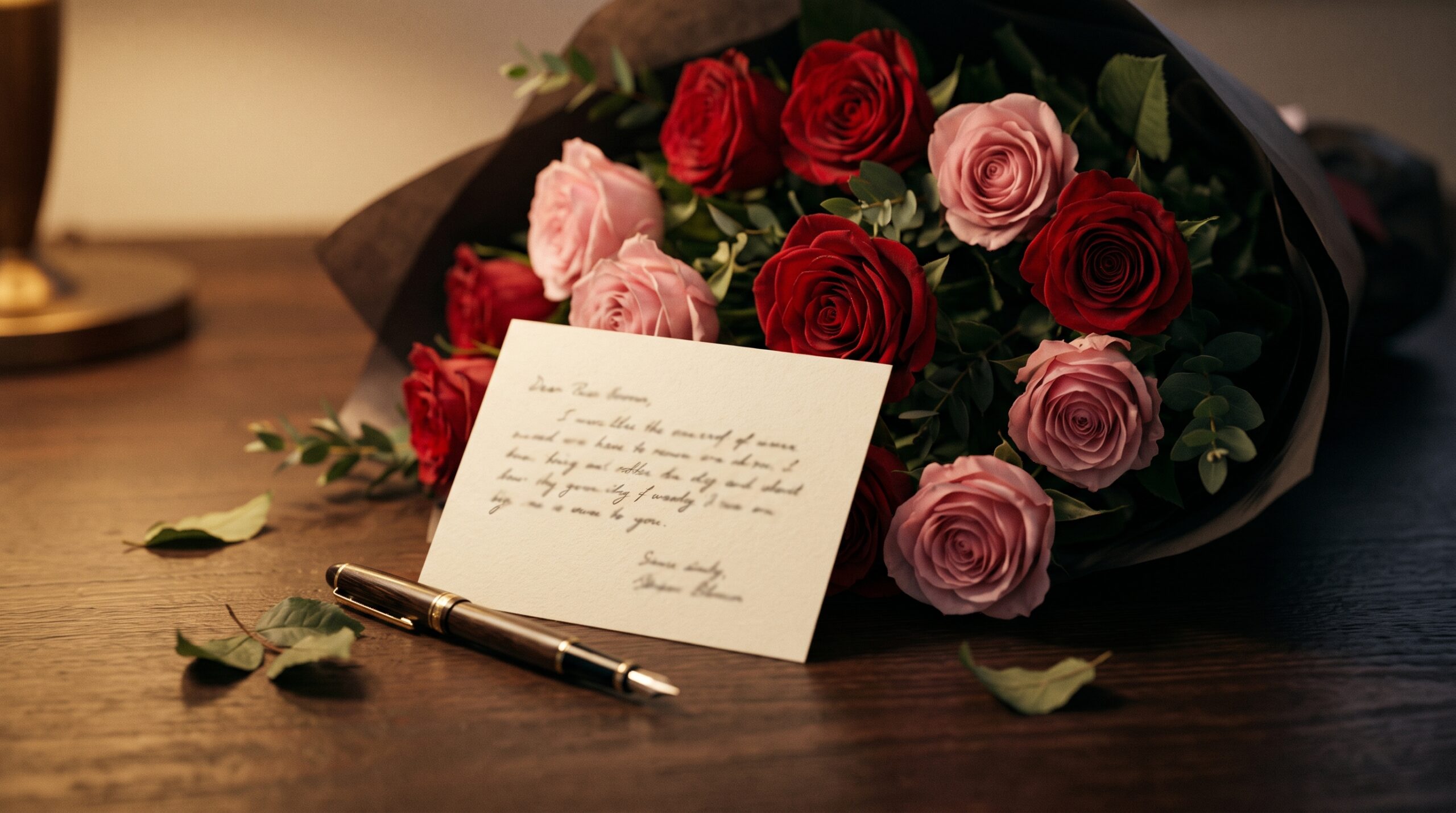
Key Takeaways
- Ten to forty words. Shorter reads as confident, longer reads as anxious.
- Name one specific thing. A line that could be printed on a thousand cards says nothing about her.
- Write in the voice you actually speak in, including Pidgin or your mother tongue if that is how you talk to her.
- Do not sign a romantic card with your full name. First name or whatever she calls you.
- Match the message to the stage. A line that is perfect at year ten is alarming at week three.
- The card outlives the flowers by a year or more. It is the part she keeps.
Why the card outlives the flowers
Customers agonise over the bouquet and then hand us a blank card, or ask us to write something nice.
That is the wrong way round, and it is worth explaining why rather than just asserting it.
Our riders hand bouquets over several times a day. What recipients talk about at the door is almost never the stem count or the colour. It is the message. They read it, and then they look up.
So the thing most senders treat as an afterthought is the thing with the longest life and the greatest effect. This page is sixty messages you can use directly or adapt, grouped by where you are in the relationship, plus the rules that decide whether a line lands or reads as something copied off a website.
Change the names. Change the details so they are true for you. A message that is almost right in your own words beats a perfect one in somebody else’s.
There is a reason to take the card seriously that has nothing to do with sentiment. The flowers have a fixed life: UMass Extension’s cut flower care guidance sets out the conditions that extend it, and even perfectly handled they are finished inside about ten days. The card is not. It goes in a drawer or on a mirror and is still there a year later, which makes it the part of your gift with the longest life by a wide margin.
The four rules
Rule one. Ten to forty words. A standard gift card holds about forty comfortably. Past that the handwriting shrinks and the message starts to look anxious. Short reads as confident, and confidence is attractive in a way that effort to impress is not.
Rule two. Say one specific thing. This is the whole game. Not you are amazing, which could be written to anyone, but you held everything together while I was travelling and I noticed. The more exactly a line could only apply to her, the more it works.
Rule three. Write in your own voice. If you have never said my beloved out loud in your life, do not write it. If you and she speak Pidgin together, write Pidgin. A message that does not sound like you reads as packaging rather than as a message, and she will feel the distance even if she cannot name it.
Rule four. Sign with your first name or whatever she calls you. Love, Tunde Adeyemi is a contract. Tunde is a person.
There is a fifth that is not quite a rule. Do not ask us to write it unless you are genuinely stuck. We are good at it and we do it several times a week, and it is still better coming from you.
Looking for inspiration? Browse our Love and romance cards or see Romantic flowers in Lagos.
Early days: the first few months
The register here is warm but unburdened. The commonest mistake is overshooting into declarations that have not been earned yet, which reads as pressure rather than romance.
- I was thinking about you, so I did something about it.
- No occasion. You just crossed my mind and stayed there.
- I am enjoying this. Thought you should know.
- You make an ordinary Tuesday feel like something.
- Still thinking about what you said on Friday.
- These made me think of you, which is happening a lot lately.
- Looking forward to Saturday more than I should admit.
- You laughed at my joke. That counts for a lot.
- Something small, for no reason at all.
- Hope today is kind to you.
- Just because. Nothing more complicated than that.
- You have been on my mind all week. Here is the evidence.
Keep the flowers modest at this stage too. An enormous arrangement in month two creates an expectation and can read as intensity rather than interest.
Established: a year or more in
The register broadens. You can be specific about shared history, and you should be, because that is what you have that nobody else does.
- Still the best decision I ever made.
- A year of you. Easily the best one.
- I would pick you again. Every time. Without thinking.
- You make the hard weeks survivable.
- I do not say it enough, so here it is in writing. I love you.
- Thank you for being patient with me while I figured it out.
- The house is not home until you are in it.
- You looked beautiful this morning and I forgot to say so.
- My favourite sound is still you laughing in the next room.
- You have been carrying a lot lately. I see it. Rest today.
- I am not good with words, so I sent these instead.
- Every day with you is the good part of my day.
- You deserve flowers on a random Wednesday, not just on your birthday.
- Loving you is the easiest thing I do all day.
- Some people are a season. You are the whole climate.
Married, and years in
The hardest register to get right, because the obvious things have all been said and the risk is sounding routine. Specific memory is what rescues it.
- Ten years. I would do all of it again.
- Still choosing you, loudly, in front of everybody.
- Thank you for staying through the parts nobody saw.
- I married my best friend and I am still showing off about it.
- We built this. All of it. Thank you.
- You said yes when you had options. I have not forgotten.
- Here is to us, and to all the quiet days nobody sees.
- You handle me on my difficult days. This is the smallest thank you I could manage.
- Same love. More years. Better every time.
- To the only person who knows the whole story.
- Nobody has been kinder to me than you.
- I noticed everything you did this year, even the parts you thought I missed.
- Twenty years and you still walk into a room and I look up.
- You have been the steady thing. Thank you.
- I would marry you again tomorrow, and you would still be out of my league.
Distance, absence and travel
A significant share of our orders are sent from abroad or while the sender is travelling, and that situation needs its own lines.
- Distance no be anything. I still dey here.
- Six thousand kilometres and you are still the first thing I think about.
- I cannot be there today. These can.
- Counting down. Not patiently.
- The time difference is cruel but I am thinking about you at the right moments anyway.
- Home is wherever you are, which makes this a long way from home.
- I will be back soon. In the meantime, these.
- Missing you from a different time zone, which is somehow worse.
- Thinking of you this morning, which is your afternoon.
- You are the reason I keep checking flight prices.
Apology, when the card is romantic
Different rules apply, and this is the category people get most wrong. Short, unconditional, and never the word but. The card opens the conversation. It does not finish it.
- I was wrong. I am sorry. Can we talk?
- No excuses. I am sorry.
- I hurt you and I know it. Forgive me.
- You deserved better from me yesterday.
- I am sorry for what I said and for how I said it.
- Abeg, no vex. I don hear. I dey sorry.
- I miss you. I am sorry. Call me when you are ready.
- I know flowers do not fix it. I am starting here anyway.
Send soft pink, peach or cream for these rather than deep red. Red carries a romantic charge that can read as skipping past the apology to the making up, which is presumptuous when somebody is still upset.
Pidgin and mother tongue
The section that will do more for you than any English line on this page, and the one almost no florist offers.
There is a habit of reaching for formal English on a flower card, and it makes the message sound like a greeting card company wrote it. For a great many Nigerian recipients, a line in Pidgin or in the language you actually use at home lands considerably harder, precisely because nobody expects it on a bouquet.
- You too much. Na you be my person.
- My baby, I no fit do without you.
- Na you I want. Nobody else.
- Since I meet you, everything don better.
- I no sabi talk, so I send this one.
- Every day with you sweet me.
- You be my peace for this Lagos wahala.
- I go choose you again. And again.
- Ife mi, o se fun ohun gbogbo. (Yoruba: my love, thank you for everything)
- Ahuru m gi n’anya. (Igbo: I love you)
Check the spelling of any mother tongue phrase with a speaker before sending. Yoruba and Igbo are tonal and a written mistake can turn something touching into a joke. We write cards by hand in Pidgin, Yoruba, Igbo and Hausa at no extra cost.
What not to write
The reliable failures, drawn from messages we have been asked to write out.
A paragraph. Past forty words the handwriting shrinks and the confidence drains out of it.
A quote with nothing of your own. A line from a poem on its own reads as a search result. The same line followed by one sentence in your voice reads as thought.
Anything you would not want a third party to read. A card is handled by a florist, a rider, a receptionist and often a colleague. Assume it will be seen.
The word but, in any apology.
A joke that only works out loud. Tone does not survive handwriting, and a teasing line can read as cold on paper.
Anything that asks for something. A card that requests forgiveness, or an answer, or a call, puts her on the spot while she is holding flowers in front of a delivery rider.
And a blank card. This is the most common regret we hear, usually from somebody who meant to think of something better and ran out of time. Anything true and plain beats nothing.
Matching the message to the flowers
The card and the bouquet should agree with each other, because the flowers are read first.
Deep red roses with a short line. Red is already making the declaration, so the card does not need to repeat it. Four words beside a hundred roses is stronger than a paragraph.
Pink or peach with a warmer, longer message. The flowers are gentler, so the card can carry more.
Mixed bright bouquets with something light and playful. These read as celebration, so a solemn message fights the flowers.
A single stem with something quiet and specific. One rose with a real sentence is one of the most effective things we send, and one of the cheapest.
A plant or orchid with something about permanence. These last months, so a line about still being here works with the gift rather than against it.
And for an apology, soft colours with a short unconditional line. Everything about the delivery should say restraint, including the size.
Messages for specific moments
Situations that do not fit neatly into a relationship stage but come up constantly.
- She has had a brutal week. You have been carrying a lot. I noticed. Rest today.
- She got a promotion. Nobody worked harder for this. I am so proud of you.
- She is sitting an exam or facing something difficult. You have got this. Whatever happens, I am here.
- A birthday. Happy birthday. This year suits you. Still the most interesting person I know.
- After a loss in her family. I cannot fix this. I can be here, and I will be.
- She moved house or started a new job. New chapter. Same me, cheering loudly.
- You are in trouble but it is light. You were right. I was wrong. I hate it when that happens.
- An ordinary Wednesday. No reason. Just you.
- She is pregnant. You are doing something extraordinary. Let me carry the rest.
- First anniversary of something hard she got through. A year since. Look at you now.
- She is far from home. Sending Lagos to your doorstep.
- After a long stretch of being busy. I have been absent. These are an apology and a promise.
If you are genuinely stuck
Some practical ways out when nothing comes.
Describe her to yourself in one sentence, then write what surprised you about that sentence. The surprising part is usually the true part.
Think of a specific day rather than the relationship. The afternoon she handled something badly and still laughed about it. The specific beats the general every time.
Say the thing you keep meaning to say. Most people have one sentence they have been carrying around for months. That is the card.
Write it as you would say it out loud, then cut the first line, which is almost always throat clearing.
If it still will not come, write the plainest possible version. I love you. Thank you for everything. These are both fine and both better than a clever line that is not yours.
And if you are completely stuck, tell us the situation when you order. We do this several times a week, we will offer two or three options, and nobody here finds it strange.
Messages in her language
Beyond Pidgin, a short set in the three major Nigerian languages, because almost no florist offers them and they land harder than anything in English.
Check the spelling with a speaker before sending. Yoruba and Igbo are tonal and written without tone marks a phrase can change meaning entirely, which turns something touching into something unintentionally funny.
- Yoruba. Mo nifee re. (I love you)
- Yoruba. Ife mi, iwo ni mo fe. (My love, you are the one I want)
- Yoruba. Eyin ni ade ori mi. (You are the crown on my head)
- Yoruba. Olufe mi, mo n ronu nipa re. (My beloved, I am thinking of you)
- Igbo. Ahuru m gi n’anya. (I love you)
- Igbo. Obi m, i bu nke m. (My heart, you are mine)
- Igbo. Ezigbo m, ana m eche gi echiche. (My dear, I am thinking of you)
- Igbo. I bu ihe kacha mma meere m. (You are the best thing that happened to me)
- Hausa. Ina son ki. (I love you, to a woman)
- Hausa. Ke ce zuciyata. (You are my heart)
- Hausa. Ina tunanin ki koyaushe. (I think about you always)
- Hausa. Soyayyata, na gode da komai. (My love, thank you for everything)
The pattern that works best is an English frame with the mother tongue line at the end, because the switch is where the warmth sits and the last line is what she is left holding. We write cards by hand in all of these at no extra cost.
Ready to send? Shop Love and romance cards, or order with Red roses.
Frequently Asked Questions
What should I write on a flower card for my girlfriend?
Name her, say one specific true thing, and sign with your first name, in ten to forty words. Specificity is what makes it work, so write something that could only apply to her rather than something that could be printed on any card. ‘I was thinking about you, so I did something about it’ works for almost any stage.
How long should a romantic flower message be?
Ten to forty words. A standard gift card holds about forty comfortably before the handwriting has to shrink. Short reads as confident and long reads as anxious, and in an apology a long message reads as defensive.
Should I write the flower card in Pidgin?
Yes, if that is how you actually speak to her. For many Nigerian recipients a line in Pidgin or a mother tongue lands harder than formal English because it sounds like you rather than like a greeting card. Check tonal spelling in Yoruba or Igbo with a speaker first.
Should I sign my full name on a romantic card?
No. Use your first name or whatever she calls you. A full name reads as formal and distant on a romantic message. Full names belong on business cards and condolence cards going to somebody who may not place you immediately.
What should I write with an apology bouquet?
Something short and unconditional that never contains the word but. ‘I was wrong. I am sorry. Can we talk?’ works for almost any situation. Do not explain your side on the card, because she cannot reply to it and it will read as an argument rather than an apology.
Can the florist write the card for me?
Yes, and at Lovebug Florist it is handwritten and included free. Tell us the situation and we will offer two or three options, which we do several times a week. It is still better coming from you, because she knows your voice and will hear it.
What should I never write on a flower card?
A paragraph, a quote with nothing of your own added, the word but in an apology, anything that asks her for something while she is standing in front of a delivery rider, and anything you would not want a receptionist to read. And never leave it blank, which is the regret we hear most.
Summary
The card is the part of the gift with the longest life. The flowers finish inside about ten days even when handled perfectly. The card is in a drawer a year later.
Four rules carry everything. Ten to forty words. One specific thing that could only apply to her. Your own voice, including Pidgin or your mother tongue. First name only.
Match the register to the stage. A line that is perfect at year ten reads as pressure at week three, and a line that is charming early sounds thin after a decade.
For apologies, short and unconditional, never the word but, and soft colours rather than deep red. The card opens the conversation. It does not conclude it.
And never leave it blank. Something plain and true beats nothing every single time, and a blank card is the most common regret we hear at the counter.
Leave a Reply