Key Takeaways
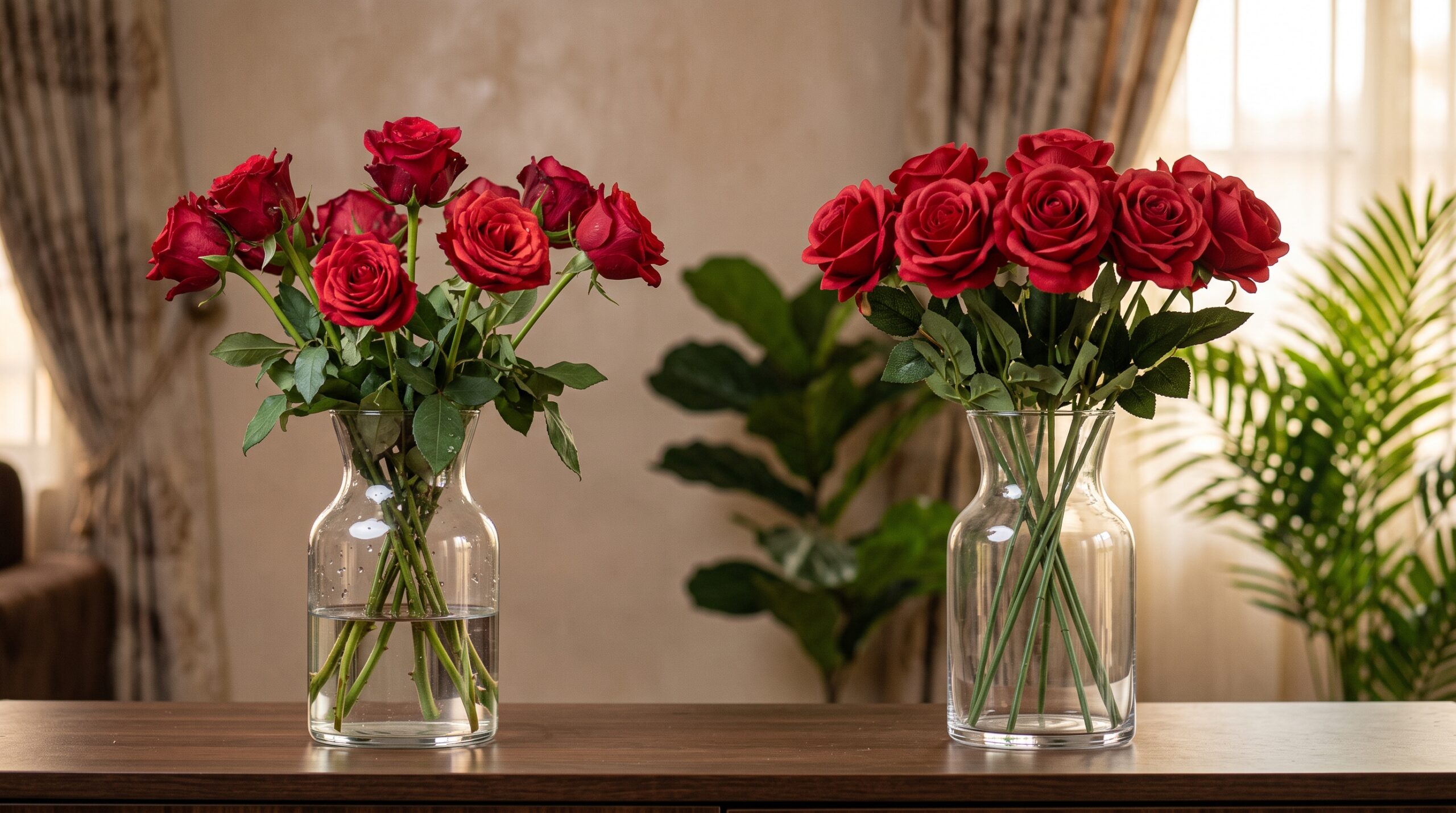
- Fresh flowers are for giving. Artificial flowers are for furnishing. Almost every argument about them collapses once you separate those two jobs.
- Artificial is not cheaper in Lagos over five years once you count dust. Good artificial stems cost N4,000 to N12,000 each and the dust in this city makes them look tired long before they wear out.
- Harmattan is the reason most artificial arrangements in Lagos look wrong. Fabric petals hold fine dust in a way glass and painted wood do not.
- Fresh stems in Lagos give eight to ten days with correct conditioning, not three. Most short vase life here is a handling failure, not a climate one.
- Artificial is genuinely the right answer for hard to reach spots, hotel and office lobbies on a fixed budget, and anyone with a serious pollen allergy.
- Artificial flowers fail completely as a gift. The gesture in a bouquet is partly that it will not last, and removing that removes the point.
- A live plant beats both for a space that needs permanent greenery, and it costs less than a comparable artificial arrangement.
- We do not sell artificial flowers. This comparison still names the four situations where they beat us.
The question people are actually asking
When someone in Lagos asks whether to buy fresh or artificial flowers, they are usually asking one of two completely different questions and have not separated them yet.
The first question is about a gift. Someone has a birthday, an apology, an anniversary, a bereavement, and they want to send flowers. For that question the answer is short, and I will give it now rather than make you read for it: fresh, always, without exception. More on why further down.
The second question is about a room. A reception desk, a dining table, a hotel lobby, a shelf in a sitting room that looks empty. The owner wants it to look furnished and does not want to think about it again. That is a real question with a real answer, and the answer is sometimes artificial.
Almost every argument you will read about fresh versus artificial is two people answering different questions at each other. One is talking about gifting and the other is talking about interior decoration, and both are right inside their own question.
A florist writing this has an obvious bias, so here is mine stated plainly. We sell fresh flowers. We do not sell artificial flowers and we have no plans to. That is a commercial position, not a moral one, and it means you should read what follows knowing I profit from only one of these answers. I have tried to compensate by being specific about where artificial wins, and I have named four situations where you should not buy from us at all.
What each one actually is
The vocabulary around this is deliberately slippery, so it is worth being precise.
Fresh cut flowers are living plant material that has been severed from its root system. Most of what reaches Lagos is grown at altitude in Kenya or Ethiopia, cut, graded, cooled, flown in, and conditioned on arrival. From the moment of cutting the stem is on a clock, and everything a florist does afterwards is about slowing that clock down.
Artificial flowers in the Lagos market fall into three tiers that behave very differently, and lumping them together is how people end up disappointed.
Entry level artificial is injection moulded plastic, often with a visible mould seam, in colours that do not occur in nature. These cost a few hundred naira a stem in open markets. They read as fake from across a room and they discolour in direct sun within a year.
Mid tier artificial is polyester fabric petals on a wire stem, sometimes with a plastic coating on the leaves. This is most of what is sold as quality artificial in Lagos, usually between N2,000 and N6,000 a stem. It passes at conversational distance and fails on touch.
Real touch artificial is latex or polyurethane coated, moulded from actual flowers, with weight and give in the petal. This is the only tier that genuinely deceives people. It costs N6,000 to N12,000 a stem in Lagos for the better imports, which means a full arrangement runs well into six figures.
When someone tells you artificial flowers look terrible, they are usually describing tier one. When someone tells you nobody can tell, they are usually describing tier three and quietly not mentioning what they paid.
Looking for inspiration? Browse our All fresh flowers or see Mixed flower bouquets.
The five year cost, calculated properly
The strongest argument for artificial flowers is financial, and it is usually made badly. Let me make it properly, including the parts that work against my own business.
A medium fresh arrangement in Lagos from a real florist runs N60,000 to N150,000. Say N80,000 for a good mixed bouquet. If you replaced that monthly for five years you would spend N4.8 million. That number is correct and it is large.
A comparable permanent arrangement in real touch artificial, say twenty five stems plus a vessel, lands around N250,000 to N350,000 in Lagos at current import prices. On the face of it artificial wins by a factor of fifteen.
Except almost nobody buys fresh flowers monthly for five years. The actual fresh flower customer in Lagos buys for occasions: six to twelve times a year including birthdays, an anniversary, Valentine’s Day, Mother’s Day, a bereavement, a congratulations. Those are gifts going to other people. They were never an alternative to furnishing your own shelf.
So the honest comparison is not fresh versus artificial. It is artificial versus an empty shelf, or artificial versus a plant, because the fresh flowers were being bought for a different purpose entirely.
And once you narrow it to that, the artificial number needs two corrections that the pitch never includes. The first is dust, which I will come to at length because in Lagos it dominates everything. The second is fashion. An arrangement bought in 2021 looks like 2021. Interiors move, and a permanent object in a visible position is a commitment to one look for as long as you keep it.
Harmattan, dust, and why artificial arrangements in Lagos look wrong
This is the part of the comparison that generic advice written for other countries gets badly wrong, and it is the single most important practical point on this page.
Lagos is a dusty city year round and during harmattan it is severely dusty. Fine particulate settles on every horizontal surface and it settles into every texture. Glass wipes. Painted wood wipes. Fabric does not wipe.
A polyester petal has a surface that fine dust keys into. After six weeks in a Lagos sitting room, a white artificial rose is grey in the creases and the colour has gone flat. It has not broken. It has not faded in the chemical sense. It has simply accumulated a layer of Lagos.
Cleaning it is really difficult. You cannot wash fabric petals without deforming them or lifting the dye. Compressed air moves the dust around the room. The methods that work are a soft brush stem by stem, or a hair dryer on cold, and either way you are looking at a real amount of time per arrangement, every month, forever.
This is why so many artificial arrangements in Lagos offices and homes look subtly wrong without the owner being able to say why. They are not badly made. They are dusty, and because they are permanent, nobody has a prompt to deal with them. A fresh arrangement gets thrown out after ten days whether you maintain it or not, which means the dust problem resets itself by design.
I would put it like this. In a dry temperate climate the maintenance argument favours artificial clearly. In Lagos it is much closer than anyone selling artificial flowers will tell you, and in a room with open windows near a main road artificial loses.
Does fresh really only last three days in Lagos?
This belief is extremely common here and it is mostly wrong. It is also the single biggest driver of artificial flower sales in this market, so it deserves a direct answer.
Correctly handled imported stems in a Lagos home give eight to ten days. Chrysanthemums and carnations go longer, often two weeks. Roses sit in the middle at around eight. Hydrangeas and lilies are shorter and more demanding.
When flowers die in three days in Lagos, the cause is almost always one of a small number of handling failures rather than the climate itself.
The stem was never conditioned on arrival. Cutting a stem draws air into the water conducting tissue and that blockage has to be cleared by recutting under water. A stem that was never conditioned is drinking through an air lock from the first hour.
The flowers were bought from someone holding them at room temperature. Cold chain is the entire game in cut flowers. A florist without a cold room is selling you stems that have already spent their vase life sitting in heat.
The water was never changed. Bacteria in vase water block the stem from the bottom up, and in Lagos ambient temperatures that population doubles fast. Two days of unchanged water in this heat does more damage than a week of it in London.
The vase was placed in sun or under an air conditioner vent. Direct sun cooks the bloom and a cold draught dehydrates it, and a surprising number of Lagos arrangements end up in exactly one of those two positions because that is where the nice table is.
Or there was fruit in the room. Ripening fruit releases ethylene, and ethylene at very low concentrations ages flowers rapidly. A bowl of bananas next to a bouquet is a slow poisoning. This is the one nobody guesses.
Where artificial flowers truly win
I would rather lose a sale than have someone buy fresh for a job fresh cannot do. These are the situations where you should buy artificial and not call us.
- Positions you cannot reach. A high shelf, a stairwell ledge, the top of a wardrobe, a mantel above a television. Anything that needs a ladder to water is not a fresh flower position, and fresh flowers in an unwatered vessel are a worse outcome than good artificial.
- Commercial lobbies on a fixed annual budget. A hotel or office that needs eight arrangements looking acceptable every day of the year, with no staff member whose job is flowers, is describing artificial. Fresh at that scale is a service contract, and if the budget is not there, artificial beats dead fresh flowers in a reception area.
- Serious pollen allergy. If someone in the house reacts to pollen, the conversation is over. There are low pollen fresh options and we will happily build one, but if the reaction is severe, do not take the risk for a decorative object.
- Permanent event and venue dressing. A ceremony arch, a photo wall, a backdrop that gets reused monthly. Nobody should be buying fresh stems for a structure that exists to be photographed from two metres away forty times a year.
- Very long distance shipping where fresh is impossible. If you are sending something to a town with no florist and no reliable cold chain, a good artificial arrangement that arrives intact beats a fresh one that arrives dead.
- A keepsake bouquet replica. Some people want a copy of their wedding bouquet to keep. That is a legitimate thing to want and fresh cannot do it.
Where artificial flowers fail completely
And these are the situations where artificial is not a cheaper version of the right answer, it is the wrong answer.
Every gift. This is the big one. Part of what a bouquet communicates is that someone spent money on something that will be gone in a week. The impermanence is not a defect being tolerated, it is the message. You are saying this moment was worth spending on even though nothing will be left. An artificial bouquet says the opposite, that you wanted the gesture to be efficient. Recipients feel this immediately even when they cannot articulate it, and they will be polite about it, and they will remember.
Romance of any kind. Anniversary, Valentine’s Day, a proposal, a date. A permanent plastic object standing in for a romantic gesture is a difficult signal to recover from.
Apology. An apology bouquet works partly because it costs you something and partly because it will not be sitting there in six months as a monument to what you did. Artificial apology flowers are a permanent exhibit of the argument.
Sympathy and condolence. Fresh flowers at a Nigerian funeral or in a bereaved home are a strong and well understood gesture. Artificial ones read as a wreath bought once and reused, which is the exact impression nobody wants to give a grieving family.
Corporate gifting to a client or partner. The recipient knows roughly what things cost. An artificial arrangement arriving from a company reads as a procurement decision, and procurement decisions are not gifts.
Hospital and get well. Beyond the gesture, many wards restrict what can come in, and a permanent object is one more thing the patient has to carry home.
The part of the artificial argument nobody prices in
Every pitch for artificial flowers is built on a single word, which is permanent, and permanence is presented purely as a benefit. It is also a liability, in three ways that are worth pricing before you commit.
The first is taste. An arrangement bought today is a decision about how your room looks for as long as you keep it. Interiors move. The dusty pink and brass look that read as current a few years ago now dates a room precisely, and a permanent object in a visible position has no graceful way out other than being replaced, which is the cost you were trying to avoid.
The second is that artificial flowers do not fail cleanly. A fresh arrangement dies obviously and you throw it out. An artificial one degrades so slowly that nobody notices, which means it sits looking slightly wrong for a year or two before anybody decides to act. The absence of a deadline is sold as the benefit and it is also the trap.
The third is disposal, and it is the one that never appears in a product description at all.
There is a part of the artificial flower argument that the usual pitch leaves out. An artificial stem is polyester, polyethylene and wire, and when it is finally thrown away it does not go anywhere. Nigeria has been tightening its position on exactly this category of waste: the National Environmental Standards and Regulations Enforcement Agency lists both a plastic, rubber and foam sector regulation and a dedicated plastic waste control regulation among the rules now in force. A fresh stem composts in a few weeks. An artificial one outlives the person who bought it.
The option both sides keep forgetting
If the actual need is permanent greenery in a space, there is a third answer that beats fresh and artificial on most measures and almost nobody raises it.
A live plant.
It is permanent in the way artificial is, because it does not need replacing every fortnight. It is alive in the way fresh is, because it grows, responds to its position and looks like a living thing. It cleans rather than accumulates, since you wipe the leaves of a rubber plant or a peace lily with a damp cloth and it is in practice clean, which is not available to a polyester petal.
It costs far less than comparable artificial. A mature plant in a good vessel in Lagos runs a fraction of what a real touch artificial arrangement of similar visual weight costs.
And it suits the climate. Most of the standard indoor plants in the trade are tropical species, which means a Lagos sitting room is closer to their native conditions than a flat in Manchester. The plants that struggle in Europe under grow lights are the ones that thrive on a Lagos balcony with no intervention at all.
The honest caveat is that a plant is not zero maintenance. It needs watering, roughly weekly, and it needs a position with the right light. If the entire appeal of artificial was never thinking about it again, a plant does not solve that. But if the appeal was the cost of replacing fresh flowers, a plant solves it better than artificial does and looks better doing it.
For a reception desk, a dining table that needs something permanent, a bedroom corner or an office shelf, this is usually the answer we give. It is a smaller sale than a large bouquet and we give it anyway, because the alternative is a customer who buys fresh for a job fresh cannot do and concludes that flowers are a waste of money.
How to buy artificial flowers well, if that is your answer
No argument from me. If you have read the above and artificial is right for your situation, buy it properly, because the difference between good and bad artificial is larger than the difference between fresh and artificial.
- Buy fewer, better stems. Twelve good stems in a proper vessel beats forty cheap ones. Density is what makes cheap artificial read as cheap: real arrangements have air in them.
- Touch it before buying. If a petal feels like a crisp packet, put it down. Real touch materials have weight and a slight resistance, and you can feel the difference blind.
- Check the stem, not the bloom. Good artificial has a wrapped, slightly irregular stem with believable leaf nodes. Bad artificial has a smooth green plastic tube, and your eye reads that tube as fake even when the bloom is convincing.
- Avoid pure white and avoid anything glossy. White artificial shows Lagos dust faster than any other colour and gloss reads as plastic under any light. Cream, blush, dusty pink, deep red and sage hide dust and read as fabric.
- Reject visible mould seams and reject symmetry. A ridge down the petal is the giveaway, and so is a bloom where every petal is identical, because real flowers are not symmetrical.
- Mix in real foliage or dried material. One or two real elements, dried eucalyptus or preserved foliage, lift an artificial arrangement considerably because the eye calibrates on the real material and extends the benefit to the rest.
- Keep it out of direct sun. Dye in artificial petals fades under Lagos sun faster than most people expect, and it fades unevenly, which looks worse than fading uniformly.
- Plan the cleaning now. Decide monthly or quarterly, pick the method, and put it somewhere you will really see it. An artificial arrangement with a cleaning schedule looks good for years. One without a schedule looks bad in two months.
What we tell customers who ask
This is the conversation as it usually goes in our shop, because the real question is nearly always hiding behind the one asked.
Someone comes in and asks whether we do artificial flowers. We say no, and then we ask what it is for.
If the answer is a gift, we talk about fresh and the conversation is straightforward. Nobody who wants to send flowers to a person is better served by artificial, and I have never once regretted saying so.
If the answer is a position in their home, we ask where. If it is reachable and they will water it, we suggest a plant or a small repeating fresh arrangement. If it is a high ledge or a stairwell, we tell them to buy artificial and we tell them what to look for, which is most of the list above.
If the answer is a reception area or a hotel, we quote a service arrangement, and if the budget is not there we say so plainly and tell them artificial is the better choice at that number. A reception desk with tired fresh flowers damages a brand more than good artificial does.
If the answer is a wedding, we talk about where each belongs. Fresh for anything held, carried or close to a person, so bouquets, buttonholes, table centres, the top table. Artificial or silk is defensible for structures, so arches, backdrops and anything three metres up that nobody will stand next to. That split saves real money on a wedding budget and almost no florist volunteers it.
The thread through all of it is that fresh and artificial are not competitors. They are two different products that happen to be the same shape, and the mistake is choosing between them rather than working out which question you are asking.
The comparison in one place
If you want it reduced to the lines that in fact matter in Lagos.
- Lifespan: fresh gives eight to ten days with correct handling. Artificial gives two to five years before the material itself looks wrong, less in direct sun.
- Cost per use: fresh is N60,000 to N150,000 per occasion. Artificial is N250,000 to N350,000 once for a comparable real touch arrangement, plus your time cleaning it.
- Lagos dust: fresh resets every ten days by being thrown away. Artificial accumulates and needs active cleaning, which is the thing most owners never do.
- As a gift: fresh works. Artificial does not, and the gap is not close.
- For a high or unreachable position: artificial, clearly.
- For permanent greenery in a reachable position: a live plant beats both on cost, appearance and maintenance.
- Smell: fresh has it. Artificial does not, and scent is a larger share of the emotional effect than people expect.
- Allergy: artificial, if the reaction is serious. Low pollen fresh options exist for milder cases.
- Disposal: fresh composts in weeks. Artificial is plastic and stays plastic.
- Honest summary: fresh for people, plants for rooms, artificial for positions you cannot reach and budgets that cannot stretch.
Ready to send? Shop All fresh flowers, or order with Live plants.
Frequently Asked Questions
Are artificial flowers cheaper than fresh flowers in Nigeria?
Over five years, yes on paper, but the comparison is usually wrong. A real touch artificial arrangement runs N250,000 to N350,000 once, against N60,000 to N150,000 per fresh arrangement. The catch is that most people buy fresh flowers as gifts for other people six to twelve times a year, not as monthly furnishing for their own home, so the two were never substitutes. If the actual need is permanent greenery in a room, a live plant costs less than artificial and looks better.
How long do fresh flowers last in Lagos?
Eight to ten days with correct handling, and up to two weeks for chrysanthemums and carnations. The widespread belief that fresh flowers only last three days here comes from handling failures rather than the climate: stems that were never recut under water on arrival, flowers bought from a seller with no cold room, vase water left unchanged, a position in direct sun or under an air conditioner vent, or a bowl of ripening fruit in the same room releasing ethylene.
Can you give artificial flowers as a gift?
You can, but it will not land the way you intend. Part of what a bouquet communicates is that someone spent money on something that will be gone in a week, and that impermanence is the message rather than a flaw being tolerated. An artificial bouquet reads as wanting the gesture to be efficient. For apology, romance, sympathy and corporate gifting the effect is actively negative.
Do artificial flowers get dusty in Lagos?
Badly, and this is the most underrated point in the whole comparison. Fine harmattan dust keys into fabric petals in a way it does not into glass or painted wood, and a white artificial rose reads grey in the creases within about six weeks in a Lagos sitting room. It cannot be washed without deforming the petals, so cleaning means a soft brush or a cold hair dryer stem by stem, monthly, indefinitely.
What is the best alternative to both fresh and artificial flowers?
A live plant, for any position you can reach and will water. It is permanent like artificial, alive like fresh, cleans properly with a damp cloth, costs a fraction of a comparable real touch arrangement, and most indoor plants in the trade are tropical species that suit Lagos conditions better than they suit Europe. The only real caveat is weekly watering and a position with the right light.
Should I use artificial flowers for a wedding in Lagos?
Split them by function. Fresh for anything held, carried or close to a person, so bridal bouquets, buttonholes, table centres and the top table. Silk or artificial is defensible for structures nobody stands next to, so arches, backdrops and high installations. That split saves real money on a wedding budget and very few florists volunteer it.
How do I tell good artificial flowers from cheap ones?
Check the stem rather than the bloom. Good artificial has a wrapped, slightly irregular stem with believable leaf nodes, while cheap artificial has a smooth green plastic tube that your eye reads as fake even when the flower looks fine. Then touch a petal: real touch latex or polyurethane has weight and slight resistance, polyester feels like a crisp packet. Reject visible mould seams, reject perfectly symmetrical blooms, and avoid pure white or glossy finishes because both show Lagos dust fastest.
Summary
Fresh and artificial flowers are not competing products. Fresh is for giving to people and artificial is for furnishing rooms, and nearly every argument between them is two people answering different questions.
For any gift, fresh wins without exception. The impermanence is part of the message, and recipients register the difference immediately even when they are too polite to say so.
The five year cost argument for artificial is real but usually misapplied, because the fresh flowers being compared were bought as occasional gifts for other people rather than as monthly decoration for your own shelf.
In Lagos specifically, dust changes the maths. Fabric petals hold fine harmattan dust, cannot be washed, and need manual cleaning every month forever, while a fresh arrangement resets the problem by being thrown away after ten days.
Fresh flowers last eight to ten days here with correct conditioning, cold chain and water changes. The three day reputation is a handling failure, not a climate one.
Artificial honestly wins for unreachable positions, commercial lobbies on a fixed budget, serious pollen allergy, reusable event structures and places fresh cannot physically reach.
For permanent greenery in a reachable spot, a live plant beats both on cost, appearance and ease of cleaning, and most indoor plants suit Lagos conditions better than they suit Europe.
And permanence cuts both ways. An artificial stem is polyester and wire that outlasts everyone who sees it, which is worth weighing against the convenience it buys.
Leave a Reply