
Key Takeaways
- White, cream and green is the professional palette. Red roses to a business contact of the opposite sex create a problem, not goodwill.
- Send to the organisation or the reception, not to an individual’s desk, unless the relationship is genuinely personal.
- Check compliance before sending to anyone in the public sector, and check your own company’s gift policy first.
- Name the reason on the card. A gift with no stated reason invites the recipient to guess, and the guess is rarely flattering.
- The receptionist, the procurement officer and the assistant are the highest return recipients and almost nobody sends to them.
- Sympathy is the one corporate occasion where flowers clearly beat every other gift, and where getting it wrong is worst.
Why corporate flowers are harder than personal ones
A bouquet to a partner has one audience. A bouquet to a business contact has several, and they all interpret it.
The recipient reads it. So does whoever signs for it at reception. So do the colleagues who walk past it for the next week. So, sometimes, does a compliance officer. Each of those readings can go differently, and a gift that delights the recipient can still cause them an awkward conversation.
Nigerian business culture adds its own layer. Relationships genuinely matter here in a way they do not in some markets, so gifting is expected rather than unusual. At the same time, scrutiny of gifts to public officials and to people in procurement roles has increased considerably, and nobody wants to be the supplier whose bouquet ended up in a gift register.
Get it right and corporate flowers do something a hamper cannot. An arrangement at a client reception is seen by every person who enters that building for a week, attributed to you, and it costs less than most companies spend on a single dinner.
Get it wrong and you have created a small ongoing problem for somebody whose goodwill you were trying to buy. This guide is about the difference.
The colour rules for business
The single most common corporate gifting error we see is a palette that reads as romantic.
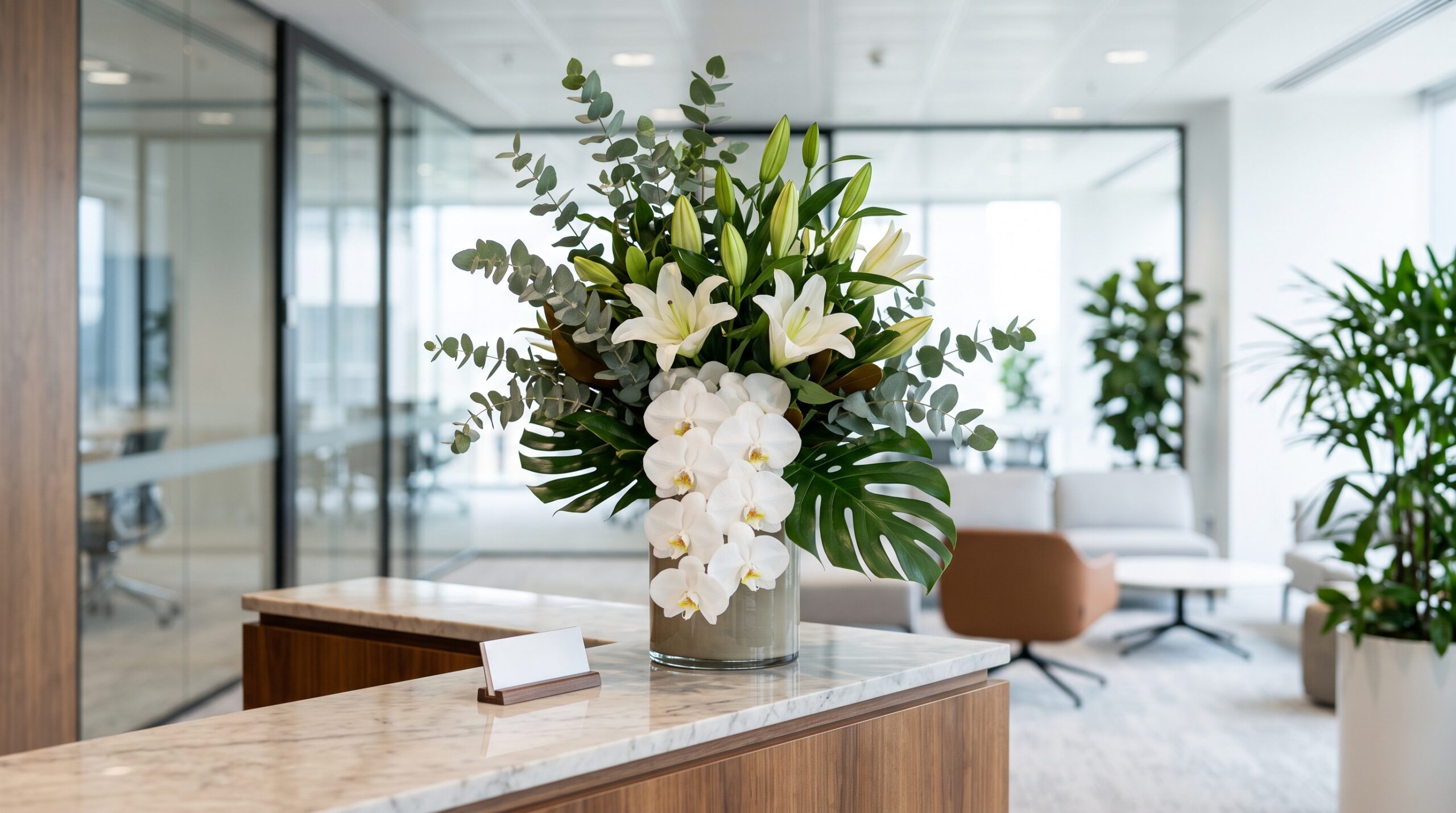
White, cream and green is the professional default. It reads as considered, formal and warm without implying anything. It photographs well in a reception. It is correct for almost every corporate occasion.
Soft structured arrangements with lilies, chrysanthemums or orchids suit a business setting better than anything rose led.
Orchids are the strongest single corporate choice. They last for months, they suit an office, they require almost nothing from the recipient, and they read as considered rather than transactional.
Bright mixed is correct for genuine celebration, meaning a launch, a promotion, a milestone or an opening. Not for routine relationship maintenance.
What to avoid. Red roses of any size to a business contact of the opposite sex. It does not matter what the card says, the flowers will be read first and the card second, and you have put the recipient in a position they did not ask for. We will raise this if a customer orders it, once, politely.
Avoid pink in a romantic register for the same reason. Pale pink within a mixed white arrangement is fine. A dozen pink roses is not.
And avoid anything novelty, anything with a slogan, and anything heavily branded, which converts a gift into marketing and is received accordingly.
Looking for inspiration? Browse our Corporate flowers in Lagos or see Congratulations flowers.
Who to send to
The list most companies write and the list that actually generates goodwill are different documents.
Clients and senior stakeholders are on everybody’s list, and they receive a great deal. Your arrangement competes with several others and needs to be either better or better timed to register.
The people nobody sends to are where the return is. The receptionist who has put your calls through for a year. The procurement officer who pushed your invoice through. The executive assistant who found you fifteen minutes in a full diary. The dispatch partner who saved a delivery in March. These gifts cost the least and are remembered the longest, precisely because they are so rare.
Your own staff. Flowers to a team member’s home after a hard project period lands differently from anything given at the office.
Suppliers. Gifting down the chain rather than only up is unusual in this market and it is noticed.
A new business that has just opened. A congratulations arrangement from a company they have not yet worked with is one of the most effective introductions available, and almost nobody does it.
And somebody who has just left. A leaving arrangement from a supplier, not their employer, is remembered for years and costs very little. People move. They remember who acknowledged them on the way out.
The compliance question nobody wants to ask
This section exists because florists avoid it and customers get caught out.
The first question is always who the recipient is. A private sector client in a commercial role is one thing. A regulator, a civil servant, a procurement officer in a public institution or anyone involved in awarding contracts is another entirely.
Many organisations in Nigeria now operate a gift register with a declared value threshold, and some prohibit gifts from suppliers during an active tender outright. A gift that forces a recipient to declare something, or to refuse it publicly, is worse than no gift at all.
Nobody enjoys this part of the conversation but it matters. Where a recipient is a public official, gift giving is governed by Nigeria’s anti corruption framework, administered by the Independent Corrupt Practices and Other Related Offences Commission under the ICPC Act 2000, and many organisations also run their own internal gift registers and value thresholds. We are florists, not lawyers, so the only responsible advice we can give is to check your own compliance policy and the recipient’s before sending anything to a public sector contact.
Three practical rules we would give any client. Ask the recipient’s organisation about their policy before sending, which is a normal professional question and not an awkward one. Never send anything during an active tender or procurement process. And keep corporate flowers modest in value, because flowers are more defensible than most gifts precisely because they are perishable and visibly not a store of value, and that advantage disappears if the arrangement is extravagant.
The card, and why most corporate cards waste the opportunity
A printed card reading Season’s Greetings from the team at a company is the default and it communicates nothing.
Name the reason. A gift with no stated reason invites the recipient to wonder what it is for, and in a business context the guess is rarely flattering. One specific sentence removes the ambiguity entirely.
Have a person sign it, not the company. A name means somebody chose to send this. A company name means procurement processed it.
Use the recipient’s correct name and title. A misspelled name or a wrong title undoes the whole gesture, and it happens constantly because lists get copied between spreadsheets without being checked.
Keep the branding to the card and keep it small. A discreet company name is correct. Branded ribbon and a logo on the box is a marketing drop.
Handwrite it where the relationship justifies it. We write cards by hand at no extra cost and for a senior relationship it is worth more than another fifty thousand naira of contents.
And a few lines that work: thank you for the Q3 turnaround, it mattered. Congratulations on the new role, they are lucky to have you. Thinking of your team today. Each names something real.
Occasion by occasion
What is appropriate, and what is not, for the situations that come up most.
- A new office or launch. Large, bright, structured, delivered to reception on the morning of opening. Visibility is the point, so go bigger here than you would elsewhere.
- A promotion or new role. Congratulations arrangement to the office, mid size, white or mixed. Send in the first week, not on the day, when they are drowning.
- Closing a deal. Modest and prompt. Something enormous after a signature reads as relief rather than appreciation.
- Bereavement in a client’s family. White lilies and white roses, sent fast, with a restrained card. For a Muslim family send within a day or two since burial is usually quick. This is the occasion where flowers are unambiguously the right gift and where delay is the real failure.
- Illness or hospital. Check the hospital’s policy first, since some wards do not accept flowers. Sending to the home is usually safer and lands just as well.
- A client’s milestone anniversary in business. Underused and effective. Almost nobody acknowledges a company’s own birthday.
- Thanking a team rather than a person. One large arrangement to the shared space beats individual small ones, costs less and avoids the comparison problem.
- Apologising for a service failure. Flowers alone are not an apology and will read as deflection. Fix the problem first, then send if it is still appropriate.
Reception arrangements as a standing investment
The highest return corporate flower decision is not a gift at all. It is your own reception.
A fresh arrangement in your own lobby is seen by every client, candidate, supplier and member of staff who walks in, every day. For a client facing business it is the cheapest brand asset you can buy per impression, and most Lagos offices either have nothing or have something artificial and dusty.
A standing order is the right structure. Fortnightly or monthly, at a fixed price agreed in advance, so it is one decision made once rather than something that gets forgotten until somebody notices the desk is bare.
White and green suits almost every office. It reads as professional, it does not clash with brand colours, and it photographs well behind a reception desk.
Scale it to the space. An arrangement that is too small for a double height lobby looks apologetic. One that is too large for a small reception is in the way.
And keep it fresh rather than keeping it long. An arrangement visibly past its best communicates something worse than having no flowers at all. If budget is tight, go smaller and more frequent rather than larger and stretched.
Practical delivery notes for corporate orders
The operational details that decide whether a corporate gift actually reaches a human being.
Send a clean list. Full office address, named recipient, floor, and a reachable phone number for each. The missing phone number is the single commonest cause of a failed corporate delivery in Lagos.
Flag security protocols. Several towers on Victoria Island and in Ikoyi will not admit a rider without a name on a list in advance. If we know, we plan. If we find out at the gate, the delivery fails.
Deliver mid morning. Afternoon deliveries to Lagos offices risk sitting at reception overnight, and on a Friday they sit until Monday.
Avoid Friday afternoon entirely for anything that matters.
Group by area so we can route efficiently, which improves everybody’s delivery time. Lekki, Victoria Island, Ikoyi, Ikeja and the mainland.
Ask for delivery confirmation. We can send a record of what landed where and who signed, which matters when somebody asks in January whether a particular client was covered.
And give notice for anything in December. Corporate volume collides with Christmas gifting and wedding season from the middle of the month, and the honest answer in the third week is often that we cannot promise a window.
Timing corporate gestures across the year
When you send matters as much as what you send, and most companies cluster everything into the worst possible fortnight.
December is the crowded month. Every supplier your client has is sending in the same two weeks, offices are emptying, and a meaningful share of what arrives sits unopened until January. If you send in December, send before the 20th.
January is the open goal. Nothing else is arriving, recipients are at their desks, prices are at their lowest and delivery is reliable. A January arrangement is attributed to you rather than lost in a pile, and it signals a decision rather than a seasonal obligation.
The quarter end and the project close are better triggers than the calendar. Flowers that arrive the week after a difficult delivery, naming the thing that was difficult, do more than anything sent on a fixed date.
Anniversaries of the relationship rather than of the year. A note marking twelve months as a client is rare and specific.
Avoid the week of a tender, a renewal negotiation or an audit entirely. Even an innocent gesture reads differently in those weeks and puts the recipient in an awkward position.
And avoid Friday afternoons for anything you want seen, since a Lagos office on Friday after three is already thinking about the weekend and the arrangement will sit until Monday.
Getting internal buy in for a flowers budget
A short note for whoever has to justify this line, because the objection is predictable.
The comparison that works is cost per impression. A fortnightly reception arrangement is seen by every visitor, candidate and member of staff who enters the building across the whole year. Measured that way it is among the cheapest brand expenditures a business has, and considerably cheaper than a single client dinner.
The second argument is attribution. A hamper is opened privately by one person. An arrangement sits in a shared space with a card on it for a week, which means the gesture is visible to people who were not the recipient.
The third is that it is defensible. Flowers are perishable and visibly not a store of value, which is precisely why they survive compliance scrutiny better than most gifts. That advantage disappears if you send something extravagant, which is an argument for modest and frequent rather than large and rare.
Where finance has a fair point is on discipline. An unmanaged flowers budget becomes ad hoc ordering at retail prices with no record of who received what. A standing order at an agreed price with a delivery record solves that, and we provide the record.
Flowers versus the alternatives
An honest comparison, including where flowers lose.
Versus a hamper. A hamper is opened privately by one person and taken home. An arrangement sits in a shared space with your card on it for a week. Hampers win on perceived value, flowers win on visibility and attribution.
Versus branded merchandise. Merchandise is marketing and is received as marketing. It belongs in a conference bag. Flowers are a gift.
Versus a bottle. A good bottle is excellent for a recipient you know drinks, and a genuine problem for one who does not, which you frequently will not know. Flowers carry no equivalent risk.
Versus a donation in their name. Increasingly common and genuinely well received by some organisations, particularly where gift policies are strict. Worth asking about for public sector contacts.
Versus a handwritten letter and nothing else. Underrated, free, and for a long relationship sometimes the strongest option available. We say this as a business that sells flowers.
Versus doing nothing. For a contact you have had no meaningful interaction with all year, nothing is a defensible choice. A gift that arrives without a relationship behind it reads as a mailing list.
Ready to send? Shop Corporate flowers in Lagos, or order with Sympathy and funeral flowers.
Frequently Asked Questions
What flowers are appropriate for a business contact in Nigeria?
White, cream and green is the professional default, and orchids are the strongest single choice because they last months and suit an office. Avoid red roses to a business contact of the opposite sex entirely, since the flowers are read before the card and you place the recipient in an awkward position.
Can I send flowers to a government official in Nigeria?
Check first. Gifts to public officials are governed by Nigeria’s anti corruption framework and many organisations operate gift registers with value thresholds. Ask the recipient’s organisation about their policy, never send during an active tender, and check your own company’s compliance rules before anything leaves.
Should corporate flowers go to the office or the home?
The office, in almost all cases, unless the relationship is genuinely personal. Send to reception rather than to an individual desk where possible. For a bereavement or an illness, the home is usually the better and safer choice.
Who is the best person to send corporate flowers to?
The people nobody else sends to. The receptionist who has put your calls through all year, the procurement officer, the executive assistant who found you time in a full diary. These cost the least and are remembered longest precisely because they are so rare.
What should a corporate flower card say?
Name the specific reason in one sentence and have a person sign it rather than the company. A gift with no stated reason invites the recipient to guess what it is for, and in business the guess is rarely flattering. Check the spelling of the name and the title twice.
Are flowers appropriate for a client bereavement?
Yes, and it is the occasion where flowers are most clearly the right gift. Send white lilies and white roses quickly with a restrained card. For a Muslim family send within a day or two, since burial usually happens fast and a late delivery arrives after the gathering has dispersed.
Is a reception flower subscription worth it?
For a client facing business, yes. A fresh arrangement in your own lobby is seen by every visitor and every member of staff daily, which is the cheapest brand impression available. Use a standing order at a fixed price so it is one decision rather than something that gets forgotten.
Summary
A corporate bouquet has several audiences, not one. The recipient, reception, their colleagues and sometimes a compliance officer all read it, and a gift that delights the recipient can still create an awkward conversation for them.
White, cream and green is the professional palette and orchids are the strongest single choice. Red roses to a business contact of the opposite sex create a problem no card can fix.
Check compliance before sending to anyone in the public sector, never send during a live tender, and keep corporate flowers modest, because their perishability is exactly what makes them defensible.
Name the reason on the card and have a person sign it. An unexplained gift invites a guess, and in business the guess is rarely flattering.
The highest return decisions are the ones nobody makes: flowers to the receptionist and the procurement officer, and a standing arrangement in your own reception seen by every visitor every day.
Leave a Reply