
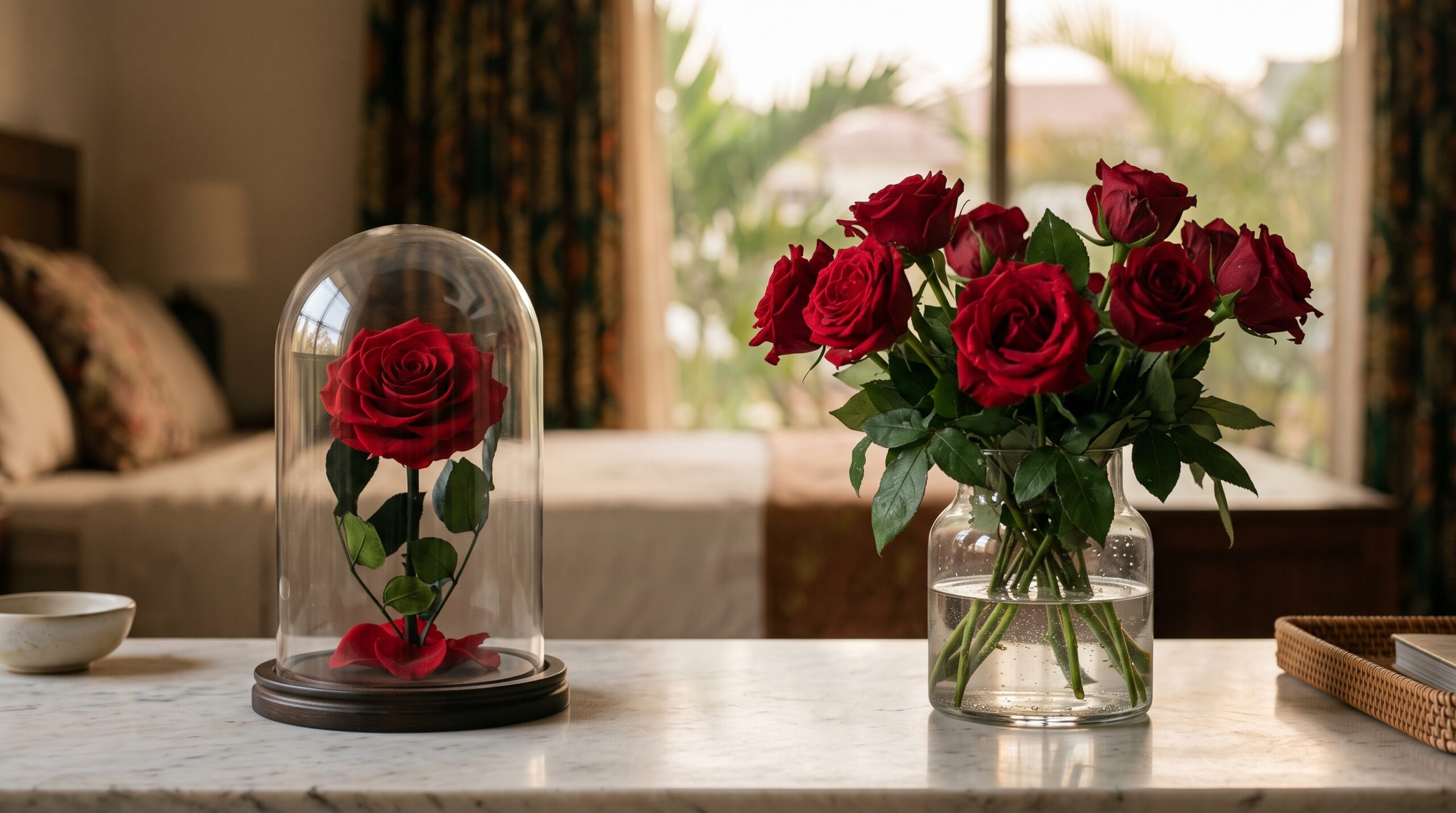
Key Takeaways
- Preserved roses are real roses treated with glycerin and dye so the petal stays soft. They are not artificial and they are not alive.
- The one year claim is a ceiling under ideal storage, not a Lagos promise. Humidity here is the limiting factor and preserved petals reabsorb moisture from the air.
- In Lagos, expect six to twelve months from a domed preserved arrangement and less from an open one. An open box near a window will disappoint you.
- Price is not comparable. Preserved arrangements in Lagos run N150,000 to N600,000 imported. Fresh roses start around N45,000.
- Preserved roses have no scent. Rose scent is a large part of the emotional effect of fresh roses and losing it changes the gift.
- Preserved wins for a keepsake, a long distance gift to somewhere with no cold chain, and anyone who wants the object to outlast the occasion.
- Fresh wins for romance, apology, sympathy and anything where the gesture should be felt now rather than displayed later.
- We do not stock preserved roses. This page still tells you when to buy them and what to check before you pay.
Why this question comes up so often now
Preserved roses in glass domes and square boxes have become one of the most visible luxury gifts in Lagos. They are on Instagram, in gift shops on the Island, and in the background of a great many proposal photographs.
The pitch is simple and very effective. Real roses, soft to the touch, that last a year instead of a week. Put like that it sounds as though someone has solved the central problem with flowers.
They have not solved it. They have traded it for a different set of problems, some of which matter a lot in Lagos specifically and almost none of which get mentioned at the point of sale.
My position, stated up front: we sell fresh roses and we do not stock preserved ones. That is a commercial decision based on how preserved material behaves in this climate, and you should weigh what follows knowing I profit from one answer and not the other. I have tried to balance that by being specific about where preserved genuinely wins, including the cases where you should buy them instead of buying from us.
What I will not do is pretend preserved roses are fake flowers. They are not, and a florist who tells you they are is either misinformed or being slippery.
What preserved roses really are
A preserved rose starts as a real rose. It is cut at a particular stage of opening, usually just before full bloom, and then the sap in the stem and petals is displaced by a preserving solution.
The solution is mostly glycerin, with water and a dye. Glycerin is hygroscopic, meaning it holds onto water, and that is the whole trick: it keeps the petal flexible instead of letting it dry brittle. The dye replaces the colour, because the natural pigment does not survive the process. This is why preserved roses come in colours no rose has ever been, including black, electric blue and metallic gold.
The stem is usually removed and replaced with a short wire or stub, because the natural stem does not take the treatment well. That is why almost every preserved arrangement sits in a box, a dome or a ceramic vessel rather than a vase. The product and the packaging are not separable.
So a preserved rose is real plant material, chemically stabilised, recoloured and detached from its stem. It is closer to taxidermy than to either a fresh flower or a plastic one, and that is the most useful way to think about it.
This also explains the texture, which is the thing people react to first. It feels like a rose petal because it is one. Mid tier artificial never achieves that and expensive real touch artificial only approximates it. On touch alone, preserved beats artificial comprehensively.
Two things to keep clear. Preserved is not the same as dried. Dried roses are air dried, keep their natural colour as it fades, feel papery and crumble. Preserved roses keep a soft petal and a saturated colour and do not crumble until much later. And preserved is not the same as freeze dried, which is a different process with a different result and a different price.
Looking for inspiration? Browse our Fresh red roses or see Long stem roses.
Do preserved roses really last a year in Lagos?
This is the claim the entire product rests on, so it deserves the most careful answer on this page.
The one year figure is not invented. Under the right conditions it is achievable, and some arrangements go considerably longer. The right conditions are a stable, dry, cool room, out of direct sun, with the arrangement enclosed.
Lagos does not provide those conditions, and the specific reason is humidity. Relative humidity in Lagos sits high for most of the year and goes higher through the rainy season. Glycerin, as noted above, holds onto water. In a humid room a preserved petal keeps taking moisture out of the air, and over months it goes from supple to slightly tacky to limp, the colour bleeds at the petal edge, and in the worst cases the dye marks whatever the arrangement is sitting on.
Add heat and it accelerates. Add a position near a window, a bathroom or a kitchen and it accelerates further.
This is not a Lagos superstition, it is how preserved plant material behaves everywhere. The University of Missouri Extension guidance on drying and preserving flowers is blunt about it: preserved flowers fade and are best replaced yearly, and material dried with desiccants readily reabsorbs moisture from the air unless it is kept sealed. Lagos simply has far more moisture in the air to reabsorb than Missouri does, so the one year claim should be read as a ceiling under ideal storage rather than a promise for a glass dome in Lekki.
What that means in practice
Translated into what you should in fact expect in a Lagos home, rather than what the packaging says.
A preserved arrangement in a sealed glass dome, kept out of sun, in an air conditioned room: six to twelve months looking genuinely good, and longer looking acceptable. The dome is doing most of the work here by limiting air exchange, and the air conditioning is doing the rest by pulling moisture out of the room.
The same arrangement in an open box in a normal Lagos sitting room, windows open, no air conditioning: three to six months before it starts to go. Still much longer than fresh, and nothing like a year.
An open arrangement near a window, in sun, in the rainy season: expect disappointment inside three months, and expect dye transfer if anything touches it.
The practical rules that follow from this are short. Buy domed or boxed rather than open if you are buying at all. Keep it in the most air conditioned room in the house. Keep it out of direct sun, because sun fades the dye unevenly and uneven fading looks worse than even fading. Do not put it in a bathroom or a kitchen whatever the shop suggests. And never add water, which is a mistake people make surprisingly often because the thing looks like a flower.
Someone selling you a preserved arrangement in Lagos with a flat one year guarantee and no conversation about where you will keep it is either not paying attention or counting on you not coming back.
The money, honestly
Preserved roses are sold as the economical choice on a cost per day basis, so let me run that calculation properly rather than dismiss it.
Preserved arrangements in Lagos, imported, currently run from about N150,000 for a small domed single rose up to N600,000 and beyond for a large box of twenty five or more. Call it N300,000 for a mid sized box as a working figure.
Fresh roses from a real florist start around N45,000 for a modest hand tied bouquet, with most orders between N60,000 and N150,000. A large arrangement or a hundred rose bouquet goes well above that.
On cost per day, preserved looks strong. N300,000 over nine good months is roughly N1,100 a day. N80,000 of fresh roses over nine days is roughly N8,900 a day. Preserved is eight times more efficient by that measure and the shops selling it are right to point that out.
The problem is that cost per day is the wrong unit for a gift. Nobody receiving flowers is amortising them. The gift does its emotional work in the first hour, and almost all of it in the first ten seconds, when the box is opened in front of the person who sent it or opened with a card from the person who did not come.
What you are buying with preserved roses is not nine months of flower. It is one moment, same as fresh, plus an object that stays in the room afterwards reminding the recipient of that moment. Whether that reminder is worth four times the price of fresh is a real question with no universal answer, and it depends almost entirely on the occasion.
Scent, and why it matters more than people expect
Preserved roses have no smell. Some are given a synthetic rose fragrance that fades within weeks, which is arguably worse than none.
This sounds like a minor point and it is not. Scent is the most direct route to memory and emotion of any of the senses, and rose scent in particular is strongly associated. A large share of what makes a fresh rose bouquet affecting is happening through the nose while the recipient thinks it is happening through the eyes.
Test it yourself. Think about the last time someone handed you flowers and what you did. Almost everybody lifts them and smells them within the first few seconds. It is close to automatic. With preserved roses that reflex fires and returns nothing.
It is a small anticlimax and it happens at precisely the moment the gift is doing its work.
The honest counterweight is that many imported fresh roses have less scent than people assume, because commercial rose breeding for export has prioritised vase life, stem strength and head size over fragrance for decades. A standard red export rose is not a garden rose. So the gap is narrower than it first appears, though it is still a gap, and it is still in fresh roses’ favour.
If scent is important to the person you are buying for, say so when you order. Scented varieties and scented companions such as lily, freesia or eucalyptus exist and we can build around them. No preserved arrangement can offer you that option at all.
Where preserved roses really win
These are the situations where I would tell you to buy preserved, and in some of them I would tell you not to buy from us.
- A keepsake tied to a specific event. A proposal, a graduation, a first anniversary. If the point is that the object stays, preserved does something fresh cannot and no amount of florist loyalty changes that.
- Long distance to somewhere with no cold chain. If you are sending to a town with no florist, preserved arrives intact where fresh arrives dead. This is a clear win and it is not close.
- A recipient who has told you they hate throwing flowers away. Some people truly find the disposal upsetting and will not say so unprompted. Believe them when they do.
- An office or desk where the recipient cannot maintain anything. A domed preserved rose on a desk needs nothing. A fresh arrangement in the same position needs water changes nobody will do.
- A gift to somebody who already receives a lot of fresh flowers. For a recipient for whom fresh is routine, preserved is the one that stands out, and standing out is often the actual brief.
- Serious pollen allergy where artificial feels too cheap. Preserved is real plant material with the pollen gone, which is a in practice useful middle position.
- Anniversary gifts where the number matters. A single preserved rose for a first anniversary that is still there on the second has a logic fresh cannot replicate.
Where fresh roses win clearly
And these are the cases where preserved is not a better version of the gift, it is a worse one.
Apology. This is the strongest case for fresh and it is worth understanding why. An apology bouquet works partly because it is temporary. It marks the moment, it is accepted or it is not, and then it goes. A preserved arrangement is a permanent exhibit of the thing you did wrong, sitting on a shelf for a year, visible to visitors. Nobody wants a monument to an argument.
Sympathy and condolence. Fresh flowers at a Nigerian funeral or in a bereaved home are a well understood gesture that fits the moment. A preserved arrangement is a permanent object handed to someone in acute grief, and it asks them to keep it.
Any gift where cost visibility is a problem. Preserved roses have well known Lagos prices. A N400,000 preserved box announces its price in a way a bouquet does not, and for some relationships, particularly professional ones, that is awkward rather than generous.
Spontaneous romance. A bouquet on an ordinary Tuesday with no occasion attached is one of the most effective things anybody can do, and it works because it is light, unplanned and disposable. Preserved roses cannot be light.
Hospital and get well. The patient is going home at some point and will have to carry it. Fresh flowers solve themselves.
Corporate and client gifting. A permanent branded object on a client desk is marketing. A fresh arrangement is a gift. Recipients read the difference accurately.
And any occasion where the scent is doing work. Mother’s Day, a birthday for someone who loves flowers specifically, a homecoming. If the person will lift it to their face, give them something that rewards that.
What to check before you buy preserved roses in Lagos
If preserved is your answer, the market here is uneven and the difference between good and bad is large. These are the questions worth asking.
- Ask whether it is preserved, dried or artificial. These three get used interchangeably by sellers and they are three different products at three different prices. Preserved petals are soft and saturated. Dried petals are papery and faded. Artificial petals are fabric or plastic and feel like neither.
- Touch a petal if you can. A properly preserved petal is supple and slightly cool, with a faint give. If it is tacky it has already taken up moisture, which means it has been sitting in a humid room and the clock started before you bought it.
- Look at the petal edges. Browning or bleeding at the edge is the first sign of degradation and it does not reverse.
- Prefer a sealed dome or a lidded box over an open arrangement, in Lagos specifically. The enclosure is doing real work against humidity and it is worth paying for.
- Ask where it was preserved and when. Most preserved roses in this market are imported from Ecuador, Colombia or China, and the product has a shelf life before it reaches you. A box that has been in a Lagos stockroom through a rainy season is not new.
- Check the dye against something white. Press a petal gently onto a white tissue. Any transfer means it will mark the surface it sits on, and it will mark clothes.
- Be careful with black, blue and metallic. These are the most heavily dyed, and heavy dye is the first thing to bleed in humidity. The dramatic colours are the ones most likely to disappoint.
- Ask what the guarantee really covers and get it in writing. A one year claim that comes with no storage instructions is not a guarantee, it is marketing.
The hybrid worth considering
For a lot of the occasions where people hesitate between the two, there is a combination that works better than either and costs less than preserved alone.
A fresh bouquet now, and one preserved stem as the keepsake.
The fresh bouquet does the work in the moment. It has scale, it has scent, it is handed over, it is photographed, and it goes in a vase where it is seen by everyone who visits for the next week and a half. That is where the emotional return on flowers in practice sits.
The single preserved stem, domed, is the object that stays. It is small, it is cheap relative to a full preserved box, it needs no maintenance, and it carries the memory forward without the recipient having to keep a large permanent display they did not choose.
The cost works out well. A good fresh bouquet plus a small domed preserved rose typically lands under what a mid sized preserved box costs on its own, and it delivers both halves of what people are in fact trying to buy.
For a proposal in particular I would recommend this over either option alone. The bouquet is for the day. The dome is for the shelf. They are doing different jobs and neither has to compromise to do both.
The one caveat, said plainly because it is my own commercial interest at stake: we can build the fresh half and we cannot supply the preserved stem, so this recommendation involves you buying from someone else as well. It is still the right recommendation.
The comparison in one place
The lines that decide it.
- Lifespan in Lagos: fresh gives eight to ten days. Preserved gives six to twelve months domed in air conditioning, three to six months open in a normal room.
- Price: fresh from about N45,000, typically N60,000 to N150,000. Preserved from about N150,000 small, N300,000 mid, N600,000 and up for large.
- Scent: fresh has it, though less than garden roses. Preserved has none, and the recipient reaches for it anyway.
- Touch: both feel like real petals, because both are. This is where preserved beats artificial outright.
- Colour: fresh is limited to real rose colours. Preserved comes in anything, including colours that are the main reason to buy it and the first thing to bleed.
- Maintenance: fresh needs water changes and a cool position. Preserved needs no water ever, and needs a dry room, which in Lagos is the harder ask.
- Humidity risk: fresh has none worth naming. Preserved has a real one, and it is the single biggest reason the one year claim does not travel to this city.
- For apology, sympathy, spontaneous romance and corporate gifting: fresh, clearly.
- For a keepsake, long distance delivery, a desk nobody maintains or a recipient who dislikes disposal: preserved, clearly.
- Best of both: a fresh bouquet now plus one small domed preserved stem, which usually costs less than a mid sized preserved box.
Ready to send? Shop Fresh red roses, or order with 100 roses bouquet.
Frequently Asked Questions
Are preserved roses real roses?
Yes. A preserved rose is a real rose whose sap has been replaced with a glycerin based solution and a dye, which keeps the petal soft instead of letting it dry brittle. The natural pigment does not survive the process, which is why preserved roses come in colours no rose grows in, including black and metallic. The natural stem is usually removed and replaced with a short wire, which is why they are almost always sold in a box or a dome.
How long do preserved roses last in Nigeria?
Expect six to twelve months looking honestly good if the arrangement is domed or boxed and kept in an air conditioned room out of direct sun, and three to six months for an open arrangement in a normal Lagos sitting room. The widely advertised one year figure assumes stable dry conditions, and Lagos humidity is the limiting factor because the glycerin in the petal keeps taking moisture out of the air.
Are preserved roses worth the money?
It depends entirely on the occasion. On cost per day they look efficient, roughly N1,100 a day against N8,900 for fresh, but cost per day is the wrong unit because a gift does nearly all its emotional work in the first ten seconds. What you are buying is one moment plus an object that stays in the room as a reminder. For a proposal or a milestone that is often worth it. For an apology or a spontaneous Tuesday it is not.
What is the difference between preserved roses and dried roses?
Preserved roses are treated with glycerin and dye, so the petal stays soft and the colour stays saturated. Dried roses are simply air dried, so they keep their natural colour as it fades, feel papery and eventually crumble. Preserved roses cost several times more and last considerably longer, and sellers in Lagos use the two words interchangeably, so ask which one you are being shown.
Do preserved roses smell like roses?
No. Preserved roses have no scent, and any fragrance added to them fades within weeks. This matters more than it sounds, because almost everybody who is handed flowers lifts them to smell them within a few seconds, and with preserved roses that reflex returns nothing. The honest counterpoint is that imported fresh roses are bred for vase life rather than fragrance, so they have less scent than garden roses, but they still have some.
Can I put water in a preserved rose arrangement?
Never. There is no living stem to drink it and water will damage the preserved petals and may make the dye bleed. Preserved arrangements need no water at any point in their life, and the mistake is common because the object looks like a flower that should be thirsty.
Should I give preserved roses or fresh roses for a proposal?
Both, if the budget allows, and this combination beats either one alone. A fresh bouquet carries the moment with scale and scent and gets photographed, and one small domed preserved stem is the keepsake that stays on the shelf afterwards. A good fresh bouquet plus a single domed preserved rose usually costs less than a mid sized preserved box on its own.
Summary
Preserved roses are real roses stabilised with glycerin and dye. They are not artificial, they are not dried, and on touch they beat artificial flowers comprehensively.
The one year lifespan is a ceiling under dry stable storage, not a Lagos promise. Humidity is the limiting factor here, because the glycerin that keeps the petal soft also keeps pulling moisture out of the air.
Realistic Lagos expectations: six to twelve months for a domed arrangement in an air conditioned room, three to six months for an open one in a normal sitting room, and real disappointment for anything sitting near a window through the rainy season.
Preserved arrangements run N150,000 to N600,000 and up. Fresh roses start around N45,000. The cost per day argument favours preserved and is the wrong measure for a gift that does its work in the first ten seconds.
Preserved roses have no scent, and the recipient will reach for it anyway. That small anticlimax lands at exactly the moment the gift is working hardest.
Preserved wins clearly for keepsakes, long distance delivery with no cold chain, unmaintained desks, recipients who dislike throwing flowers away, and anybody who already gets fresh flowers routinely.
Fresh wins clearly for apology, sympathy, spontaneous romance, hospital gifts, corporate relationships and any occasion where scent does part of the work.
For a proposal or a milestone, a fresh bouquet plus one small domed preserved stem beats either option alone and usually costs less than a mid sized preserved box.
Leave a Reply