
Key Takeaways
- Send fast. For a Muslim family burial usually happens within a day, so a delivery three days later arrives after everyone has dispersed.
- White, cream and soft neutrals. Never bright multicolour, never red, and nothing that reads as celebration.
- In Nigeria a cash contribution toward burial costs is the primary gesture. Flowers are an addition, never a substitute.
- Keep the card short and do not reach for meaning. Say you are sorry, say something true about the person, offer help.
- Send to the family home rather than to the service, unless a tribute has been specifically requested.
- A delivery a month later, when everybody else has stopped, is remembered longer than anything sent in the first week.
Getting this wrong is worse than getting other things wrong
Most gifting mistakes are recoverable. A birthday bouquet that misses the mark is forgotten. A condolence gesture that lands badly is remembered, sometimes for years, by a family at the worst moment of their lives.
That is why this guide is more careful than the others, and why it includes things we would advise you not to send.
Nigerian funeral practice is also more varied than most gifting advice allows for. A Muslim burial in Lagos and a Christian one in the east follow different timelines, involve different gatherings and have different expectations about what arrives and when. Advice written for a British funeral is close to useless here, and in places actively wrong.
There is also the question of whether flowers are the right gift at all, which deserves an honest answer rather than a florist’s answer. In Nigeria they frequently are not the main gesture, and pretending otherwise would be self serving.
What follows covers timing, which flowers, what to write, the differences between observances, where to send, and what to do when you are not close enough to the family to be sure.
The cash question, answered honestly
Before anything about flowers, this has to be said clearly.
In Nigeria, contributing toward burial expenses is the primary expression of sympathy for most families. Funerals here are substantial undertakings and the costs are real and immediate. Communities organise around that, and the contribution is understood by everybody without explanation.
Flowers do not replace it. A bouquet arriving from somebody who could have contributed and did not is a weaker gesture, not a more refined one.
So the correct structure in most cases is both. Contribute as expected, through whatever channel the family has opened, and send flowers separately as the personal part.
The contribution discharges the obligation. The flowers say something individual, which a pooled contribution cannot.
If you can only do one and you are close to the family, contribute. If you can only do one and you are a professional contact or a distant acquaintance, flowers with a short card are appropriate and sufficient.
And if the family has specifically requested no flowers, which some do, respect it completely. A donation in the deceased’s name is the correct alternative and should be mentioned in your message.
Looking for inspiration? Browse our Sympathy and funeral flowers or see White roses.
Timing, which varies more than people expect
Speed matters more in Nigeria than in most places, and the right window depends on the family.
For a Muslim family, send immediately. Islamic practice is burial as soon as possible, usually within twenty four hours. A condolence delivery that arrives three days later reaches a house where the gathering has already dispersed. If you hear in the morning, send that day.
For a Christian family, the timeline is longer and more complex. There is often a period between the death and the funeral that can run to weeks or even months, particularly where family must travel from abroad or where a burial is held in the home state rather than in Lagos. There may be a wake keeping, a service of songs, the funeral itself and a thanksgiving service.
That means there are several appropriate moments rather than one. Immediately on hearing, to the family home. Before the service of songs or wake. On the day of the funeral, if a tribute has been requested. And after everything, which is the one most people miss.
The forgotten window is the most valuable. In the first two weeks a bereaved family is surrounded by people. By week five everybody has returned to their lives and the house is quiet, and that is when the loss is often hardest. A delivery at that point, with a short note saying you are still thinking of them, is remembered far longer than anything sent in the rush.
If you are unsure of the family’s observance, send to the home within a day or two. That is appropriate across every tradition.
Which flowers, and which to avoid
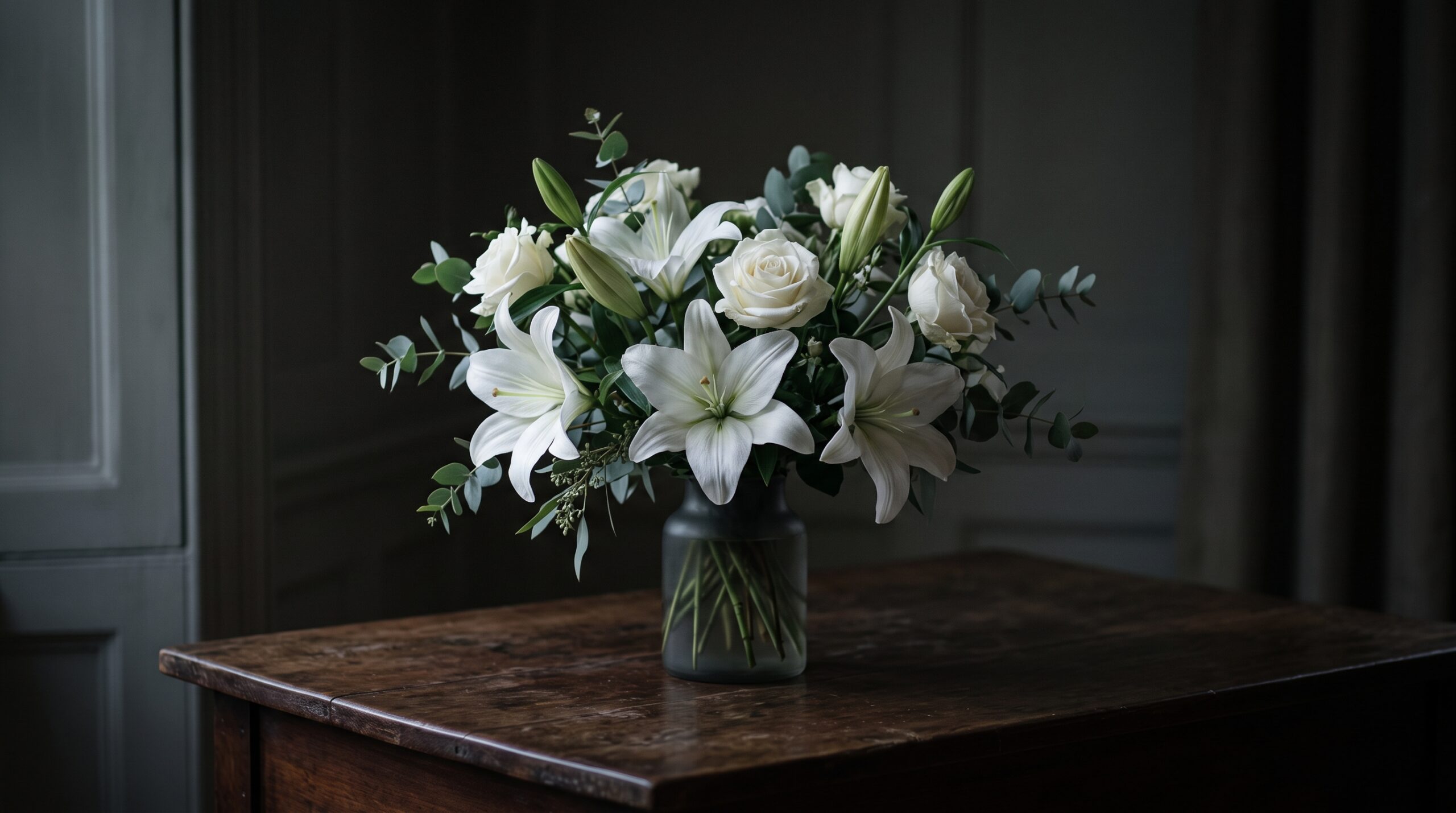
White is the colour of sympathy in Nigeria across Christian, Muslim and traditional observances. It is the safe and correct choice and nothing here argues otherwise.
White lilies are the most traditional sympathy flower and carry the meaning most clearly. They have presence, they are formal, and they are understood as a tribute without explanation.
White roses say respect, sincerity and remembrance, and they suit a more personal gesture to a close friend rather than a formal tribute.
White chrysanthemums are strongly associated with mourning and are entirely appropriate. They are also the most heat tolerant of the white flowers, which matters in Lagos.
Soft neutrals, cream and pale green foliage, round out an arrangement without introducing colour.
What to avoid. Bright multicolour, which reads as celebration and is genuinely jarring in a house in mourning. Red of any kind, which carries romantic meaning. Yellow, for the same reasons it is risky elsewhere here. Anything novelty. Balloons, obviously, though it needs saying because it happens.
One note on scent. Lilies are strongly scented and a large arrangement of them in a small enclosed room can become overwhelming over several days. For a family home rather than an open hall, a mixed white arrangement with fewer lilies is often kinder.
What to write, and what never to write
The rule in grief is restraint. Do not reach for meaning. The bereaved person has heard every available comfort ten times already today and most of them did not help.
Say three things at most. That you are sorry. Something true about the person who died, if you knew them. That you are available.
Keep it under sixty words, which is longer than we recommend for any other occasion, because extreme brevity in grief can read as coldness.
- I am so sorry. Thinking of you and your family.
- There are no words. I am here.
- He was a good man and I will not forget him.
- She touched many lives, mine included.
- With deepest sympathy to you and yours.
- Holding you in my thoughts through this.
- Sorry for your loss. Please tell me what you need.
- I am thinking of you today and in the difficult weeks ahead.
- My condolences. Take all the time you need.
- With love and deepest sympathy from everyone at the office.
What never to write. Do not say it was God’s will, even in a religious family, because it is not yours to say. Do not say they are in a better place. Do not say you know how they feel, because you do not. Do not make it about your own loss, which is the most common failure and happens with good intentions. And do not use the word but anywhere in the message.
Christian, Muslim and traditional observances
The differences that actually change what you should do.
Muslim families. Burial within a day, usually, and the gathering happens fast. Send immediately or not at all in that window. Flowers are accepted in most Nigerian Muslim families as a gesture from friends and colleagues, though they are not part of Islamic burial practice itself, so keep them modest and send to the home rather than to the mosque. A cash contribution is more clearly within tradition.
Christian families. A longer timeline with multiple gatherings. Flowers are conventional and expected, and tributes at the service itself are common. Ask the family or a close contact which events are happening and where, because sending to the wrong one is a wasted gesture.
Traditional observances vary enormously by ethnic group and region, and in many cases the funeral of an elderly person who lived a full life is a celebration rather than a solemn occasion. Colour may be entirely appropriate there, and a sombre white arrangement can even be slightly out of step. If you are not close enough to know, ask somebody who is.
Across all of these, the safest default when you genuinely do not know is a white arrangement to the family home with a short card, sent quickly. That is never wrong anywhere in Nigeria.
And if you are a professional contact rather than a friend, stay with that default rather than attempting something more personal. Formality is the correct register when the relationship is professional.
Flowers at the service itself
Tributes at a funeral service are a different product from a bouquet to a home, and they need to be commissioned differently.
Ask before you send one. Some families want tributes, some have requested none, and some have a specific arrangement with a florist already. Sending an uninvited large tribute can create a problem at a venue with limited space.
If a tribute is wanted, it is usually a standing arrangement, a wreath or a casket piece, and the family or the funeral organiser will say which.
Delivery timing has to be coordinated with the venue, not the family, who have more than enough to manage. Get the venue contact and the access window.
Scale it to the venue. A large tribute in a small church is in the way.
A card on a tribute should carry your name clearly, because the family will often look afterwards at who sent what, sometimes weeks later. This is the one condolence card where your full name is correct.
One practical matter that sounds trivial and is not. Nigerian funeral gatherings are frequently outdoors or in open halls, often for hours, and NiMet’s Seasonal Climate Prediction forecasts above normal temperatures across most of the country. Arrangements intended to stand through a service need structural flowers and a water source, because a tribute that has wilted by the second hour is noticed by everyone and distresses the family.
And agree who moves it afterwards. Tributes frequently need to go from the service to the graveside to a family home, and nobody has planned for it.
Sending as a business
Corporate condolences are common and frequently handled badly.
Send to the home, not the office. A bereaved employee is not at their desk, and a client is not thinking about work.
Send from a person as well as the company. A card signed only with a company name reads as a process. A card signed by the person who actually knew them reads as a gesture.
Keep it modest. An extravagant corporate tribute at a funeral looks like marketing, and some families find it genuinely distasteful.
Act quickly. A condolence that arrives two weeks after the news, because it went through an approval chain, has communicated exactly how it was produced.
Follow up as an individual. A manager or account lead who messages separately, a week later, with nothing to sell, is the thing that is remembered.
And if an employee has lost someone, the flowers are the smallest part. What they will remember is whether they were given room.
If you are not sure you should send at all
A common hesitation and worth addressing, because people often do nothing out of uncertainty.
If you knew the person who died, send. Distance from the family does not disqualify you, and families consistently say afterwards that they were moved by how many people the person had touched.
If you know the bereaved rather than the deceased, send. That is the whole point of condolence.
If you are a professional contact, send, modestly and formally. It is appropriate and it is noticed.
If you genuinely did not know either party and you are sending because somebody said you should, consider whether a message would be more honest than a bouquet.
If you are worried that your gesture is too small, send it anyway. The family is not comparing. Nobody has ever said afterwards that somebody’s flowers were disappointingly modest. They say they remember who showed up.
And if you have missed the window entirely, which happens because people hear late, send anyway with a card that acknowledges it. A delivery in week six with a note saying you only just heard and are thinking of them arrives when the house is quiet, which is when it does the most good.
Supporting someone after the flowers
The part that matters more than anything a florist sells, and it belongs in a guide like this.
The pattern after a death in Nigeria is intense support followed by sudden silence. The first fortnight brings visitors, calls, contributions and crowds. Then it stops almost completely, and the bereaved person is alone with it.
Put a reminder in your phone for six weeks out and another for the first anniversary. Those two moments are when almost nobody gets in touch and when it is needed most.
Say the name of the person who died. People avoid it, thinking they will cause pain. The bereaved almost universally say the opposite, that the silence around the name is worse than hearing it.
Offer something specific rather than asking what they need. A grieving person cannot answer an open question. I am bringing food on Thursday is useful. Let me know if you need anything is not.
Do not set a timeline on their grief, and do not be surprised if they seem fine and then are not.
And if you only do one thing from this entire page, make it the six week delivery. We send a great many of these and they are the ones families write back about.
Common mistakes we see
Drawn from orders we have had to question, all made with good intentions.
Sending too late for a Muslim family, because the sender was waiting to find out the funeral details. There are no details to wait for. Send the same day.
Sending something bright because the family said the funeral was a celebration of life. Even where the service is celebratory, the house in the first week is not. Keep the flowers white and let the service be the celebration.
Sending an enormous arrangement to a small flat, where it becomes a problem the family has to solve while grieving.
Writing a long message that is mostly about the sender’s own feelings. Re read any condolence card and count how many sentences are about you.
Sending to the office when the person is not at work.
Asking the family for delivery details. They have more than enough to manage. Find out from a mutual contact.
And doing nothing because you could not decide what was appropriate. This is the most common failure of all and the only one with no upside. A white arrangement to the home with four honest words is never wrong.
Ready to send? Shop Sympathy and funeral flowers, or order with Lily bouquets.
Frequently Asked Questions
What flowers should I send for a condolence in Nigeria?
White, across every observance. White lilies are the most traditional and carry the meaning most clearly, white roses suit a more personal gesture, and white chrysanthemums are the most heat tolerant for Lagos. Avoid bright multicolour, red, yellow and anything novelty.
How quickly should I send condolence flowers?
Immediately for a Muslim family, since burial is usually within a day and a delivery three days later arrives after everyone has dispersed. For a Christian family the timeline is longer with several appropriate moments. When unsure, send to the family home within a day or two, which is appropriate everywhere.
Should I send money or flowers for a bereavement in Nigeria?
Both, with the contribution first. Contributing toward burial expenses is the primary expression of sympathy for most Nigerian families and flowers do not replace it. Contribute as expected, then send flowers separately as the personal part that a pooled contribution cannot carry.
What should I write on a condolence card?
Say you are sorry, say something true about the person if you knew them, and offer to help, in under sixty words. Never say it was God’s will or that they are in a better place, never say you know how they feel, and never make the message about your own loss.
Should I send condolence flowers to the home or the funeral?
The home, unless a tribute has specifically been requested. Ask before sending anything to a service, since some families want no tributes and others have already arranged them, and an uninvited large arrangement can create a problem at a venue with limited space.
Is it too late to send condolence flowers weeks later?
No, and it is often better. In the first two weeks the family is surrounded by people. By week five everybody has returned to their lives and the house is quiet, which is frequently when the loss is hardest. A delivery then is remembered far longer than anything sent in the rush.
How should a company send condolences in Nigeria?
To the home rather than the office, quickly, modestly, and signed by a person as well as the company. An extravagant corporate tribute at a funeral can read as marketing, and a condolence delayed by an approval chain communicates exactly how it was produced.
Summary
Condolence is the one occasion where a misjudged gesture is remembered for years, so it deserves more care than any other gift on this site.
In Nigeria a contribution toward burial costs is the primary expression of sympathy. Flowers are the personal addition alongside it, never a more refined substitute for it.
Send fast, especially for a Muslim family where burial is usually within a day. White across every observance. Nothing bright, nothing red, nothing that reads as celebration.
Keep the card short and resist reaching for meaning. Say you are sorry, say something true about the person, offer help. Never say it was God’s will, and never make it about your own loss.
And consider the window everybody misses. Week five, when the visitors have gone and the house is quiet, is when a delivery does the most good and is remembered the longest.
Leave a Reply