
Key Takeaways
- Yes, overwhelmingly, but the objection is almost never the flowers. It is the money, the timing or the audience.
- The commonest complaint we hear is not about receiving flowers. It is about receiving them only once a year.
- Practicality is the real resistance. A woman who says flowers are a waste usually means she would rather the money went further, not that she dislikes them.
- Office delivery divides people sharply. Some love the public moment. Some are mortified by it. Know which she is.
- The card matters more than the flowers. Recipients mention it to our riders far more often than they mention the bouquet.
- An unprompted bouquet on an ordinary day outperforms a birthday bouquet, every time.
The honest answer, and how we know
This question comes up constantly, usually from a man who is about to spend serious money and wants reassurance, and sometimes from a woman who has been told by a friend that flowers are a waste.
The short answer is yes. In years of handing bouquets over at gates, reception desks and front doors across Lagos, the reaction is almost uniformly positive and frequently much stronger than the sender expected.
But that answer is too simple to be useful, because the interesting part is the exceptions and the conditions.
A note on evidence before anything else, because this matters.
There is no national survey on how Nigerian women feel about flowers, and anybody quoting you a percentage has invented it. What does exist is household and consumer data: the National Bureau of Statistics eLibrary publishes general household surveys and consumer price reports, which describe the spending environment every gift decision in this country sits inside. Everything else on this page is first hand observation from our own delivery records, and it is labelled as such.
So what follows is not research. It is what our riders and florists see, and what customers tell us when an order goes well or badly. That is a particular and limited kind of evidence, and it is the kind an actual florist has that a content writer does not.
What actually happens at the door
The most reliable thing we observe is the gap between what senders expect and what happens.
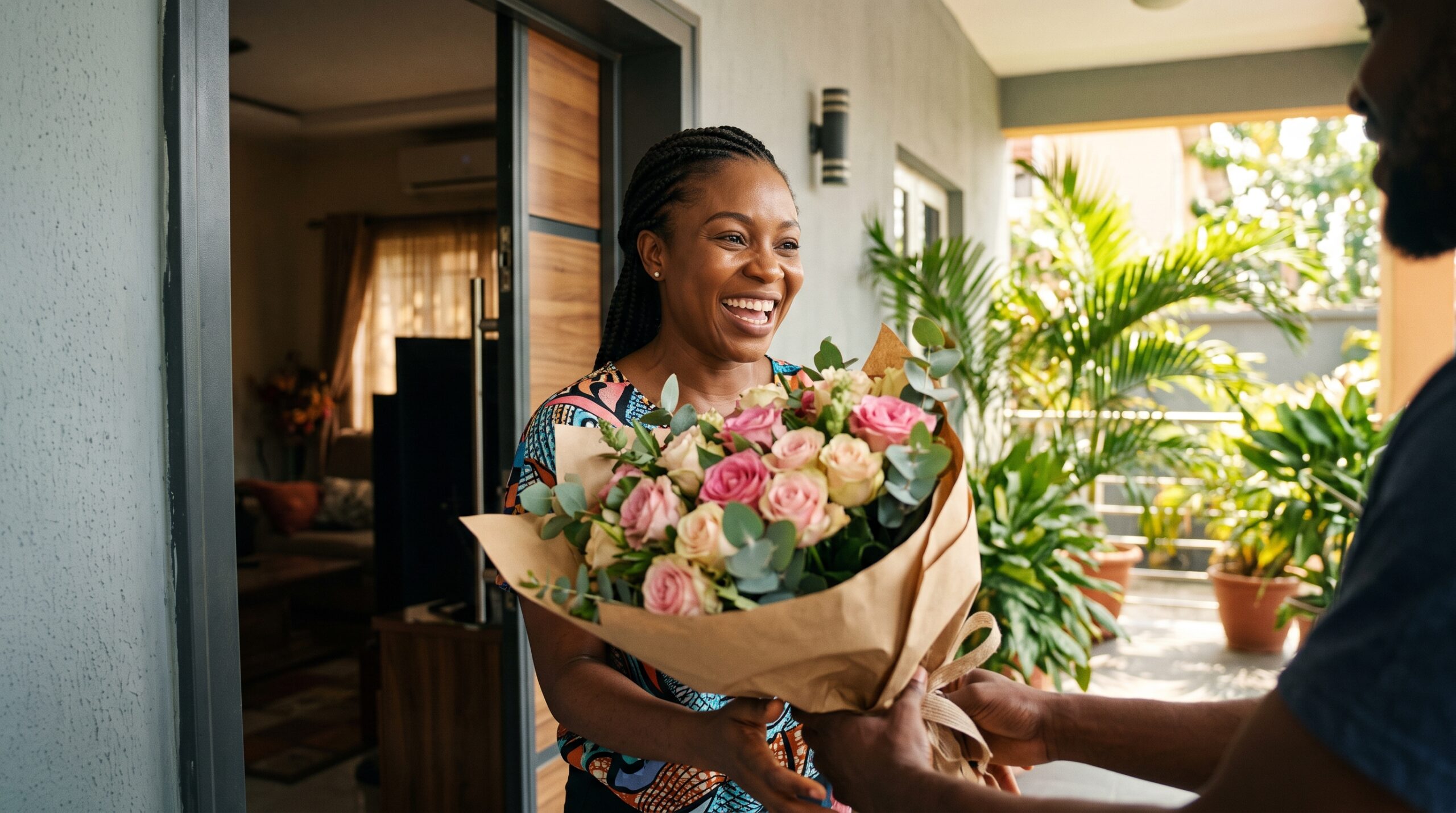
Senders expect polite appreciation. What happens far more often is a genuine reaction, the kind people are slightly embarrassed by. Women call somebody immediately. Women photograph the bouquet before taking it inside. Women ask the rider to wait while they read the card, then look up.
The second thing we see is that the reaction is strongest when the flowers are unexpected. A birthday bouquet is appreciated and anticipated. A bouquet on a Tuesday for no reason produces something different, because it carries information a birthday gift cannot: that she was thought about when there was no prompt to think about her.
The third thing, and this surprises most senders, is how often the recipient talks about the card rather than the flowers. Our riders are routinely told what the message said. Almost nobody comments on the stem count.
And the fourth, which is harder to describe: flowers arriving at a house change the house for a week. Several customers have told us their mother moved the vase from room to room, or that the arrangement became the thing everybody who visited was shown. The gift keeps working long after the moment.
None of this means every delivery lands. Some do not, and the reasons are specific and avoidable.
Looking for inspiration? Browse our Romantic flowers in Lagos or see Red roses.
The real objections, and what they actually mean
When a Nigerian woman says she does not want flowers, she is usually saying something else. Here are the things we hear.
The money objection. Some version of flowers die, so why spend that on something that dies. This is the most common by a distance, and it is rarely about flowers. It is about an economy where money is tight and a sense that the spend should be more durable. Often it comes from women who would love flowers but have decided it is not sensible to want them.
The frequency objection. This one is sharper and we hear it a lot. She does not object to flowers. She objects to flowers arriving once a year, usually on Valentine’s Day, as a box being ticked. The gift is read as obligation rather than thought, and the annual pattern is the thing being criticised.
The audience objection. She does not want a bouquet arriving at her desk in front of forty colleagues. This is not shyness. It is a reasonable preference about whether her private life is a workplace event.
The suspicion objection. Flowers arriving out of nowhere after an argument, or after a period of distance, are sometimes read as an attempt to manage rather than an attempt to connect. If a relationship is strained, flowers alone can land badly.
The practicality objection. No vase, no time, a small flat, a house with small children, a schedule that means she will not be home for three days. These are logistical and entirely solvable.
Notice that only one of these is about flowers.
Answering the money objection properly
This deserves its own section, because it is the big one and most senders answer it badly.
The bad answer is to spend more. A larger bouquet in response to the money objection confirms exactly what she was worried about.
The better answer is to change what you buy. A plant lasts years rather than days and completely removes the argument. An orchid flowers repeatedly. Preserved roses last a year or more. For a woman whose objection is durability, these are not compromises, they are the correct product.
The other good answer is to pair the flowers with something practical, so the gift is not only perishable. Flowers plus something she actually needed reads as thoughtful rather than extravagant.
And the honest answer, which works with some people, is to say what the flowers are for. A bouquet is not an investment, it is a few days of something beautiful in a house that does not usually have anything beautiful in it. Said plainly, that reframes the purchase.
What does not work is sending flowers repeatedly in the hope she comes round. If she has told you how she feels about it, believe her, and find the version of the gesture she does want.
Office delivery: read the room
A large share of our Lagos deliveries go to offices on Victoria Island, in Ikoyi and around Ikeja, and office delivery is the single most polarising decision a sender makes.
For some women it is the best part. A bouquet at reception is visible, it is talked about, and being visibly thought of at work is genuinely pleasurable. These recipients tell our riders that colleagues came over.
For others it is the worst part. A woman who is private about her relationship, or senior enough that a romantic display feels unprofessional, or simply dealing with office politics, does not want her personal life delivered to her desk.
The tell is usually how she talks about work. If she brings her colleagues into conversations at home, she will enjoy it. If work and private life are kept separate, send to the house.
If you genuinely do not know, send to the house. The downside of a home delivery is that fewer people see it. The downside of a wrong office delivery is that she spends the afternoon uncomfortable.
And if you do send to the office, write a card that is fine for a colleague to read over her shoulder. Keep the private version for home.
Men receiving flowers in Nigeria
Worth including, because it is the fastest growing category we handle and it changes the conversation.
Flowers to Nigerian men were rare until recently. They are now a meaningful share of our orders, sent by wives, girlfriends, sisters, daughters and colleagues.
The reaction is interesting. Most men who receive flowers have never received them before, and the dominant response is not embarrassment but surprise followed by genuine pleasure. Several have told our riders that nobody had ever sent them anything.
The register needs to be different. Strong colours rather than pastels, a plant rather than a hand tied bouquet for an office desk, and a card that explains itself rather than assuming the gesture is understood.
The strongest lines we write for men acknowledge the oddity directly. Something like, yes, flowers, for you, get used to it. Humour removes the awkwardness and the message lands underneath it.
And the occasions that work best are achievement and acknowledgement rather than romance. A promotion, a hard year, a thank you for carrying something. Men who find a romantic bouquet confusing understand a bouquet that says well done.
How to send so it lands
Practical rules drawn from the deliveries that go well.
- Send without an occasion. An unprompted bouquet on an ordinary day carries more information than any birthday gift, because nothing required it.
- Write a real card. The card is what she will mention. Name her, say one specific true thing, sign it. Ten to forty words.
- Match the flowers to the relationship. Deep red says romance unambiguously. Pink says affection without declaration. Send the one you mean.
- Time it for the morning. A bouquet at nine improves the whole day. One at seven in the evening improves the last hour of it.
- Make it require nothing. A vase or boxed arrangement for someone busy. Hand tied stems are a small task for the recipient.
- Send to the house if you are unsure about the office.
- Do it more than once a year. This is the one that actually changes how the gift is received, and it costs less than people assume because frequency matters more than size.
- And if she has told you she does not want flowers, send a plant instead and stop arguing about it.
What we would tell a first time sender
If you have never sent flowers in Nigeria and you are nervous about it, here is the short version.
She will like it. The risk you are worried about, that it is too much or will be found strange, is almost never the thing that goes wrong.
What goes wrong is logistics. A phone that is not answered, an address that is a description with no landmark, an office that closed early, a delivery timed for an evening that turned into traffic. Get those right and the gesture takes care of itself.
Do not over spend on your first send. A modest bouquet with a real card does more than an enormous one with a blank one, and it sets a sustainable pattern rather than a bar you then have to clear every time.
Do not send flowers to fix something serious. They open a conversation, they do not conclude one.
And tell us the situation when you order. We arrange differently for an apology, a birthday, a first date and a fifteenth anniversary, and a florist who knows what the flowers are for makes a better bouquet than one working from a price point.
What changes when flowers become normal
A pattern worth describing, because it is the most interesting thing in our order book.
The customers who send most often are not the ones who spend most per order. They are the ones for whom sending has become ordinary. A bouquet every couple of months, usually modest, often with no occasion attached.
What happens in those households is different from what happens in the once a year ones. The recipient stops treating flowers as an event and starts treating them as part of how the house looks and how the relationship sounds. The anxiety about cost falls away, because no single purchase is large. And the gesture stops carrying any suspicion, because it is not attached to anything.
Several of these customers started with a single order that went well and simply kept going. One or two now have standing orders that run without them thinking about it.
This is the honest answer to whether Nigerian women like flowers. The question assumes flowers are an event to be judged. In the households where they are routine, nobody is judging them at all, which is the condition under which they do the most good.
And it is cheaper than people expect. Three modest bouquets across a year costs roughly what one large Valentine’s arrangement costs, and does considerably more.
What to do if a delivery lands badly
It happens, and how you handle it matters more than the mistake.
If she was uncomfortable about the office delivery, do not argue that she should have enjoyed it. Note it and send to the house next time. The information is useful rather than a rejection.
If the timing was wrong, meaning she was travelling, in a difficult week, or dealing with something, acknowledge it rather than pretending it went well.
If she questioned the cost, resist defending the amount. Say what the flowers were for in one sentence and change what you buy next time.
If it arrived into an unresolved argument and was read as management rather than affection, that is a signal about the argument, not about the flowers. Have the conversation.
And if she simply did not react the way you hoped, consider that she may not be demonstrative rather than that she did not like them. Our riders see plenty of recipients who say almost nothing at the door and then message the sender an hour later.
Flowers in a relationship that is already good
Most advice about sending flowers is aimed at fixing something or marking something. The orders we most enjoy are neither.
A relationship that is working does not need flowers, which is exactly why they land so well in one. There is nothing to repair and nothing being compensated for, so the gesture carries only what it is.
The senders in this category tend to buy modestly and frequently, and they tend to write better cards, because they are not trying to say anything difficult.
What recipients in these households tell our riders is consistently about being thought of rather than about the flowers. The bouquet is evidence, not the point.
If you are already in a good relationship and have never sent flowers because there was no reason to, that absence of reason is the strongest reason there is.
And it compounds. The first unprompted bouquet is a surprise. The fourth is a pattern, and a pattern is a far better thing to be known for than a single grand gesture on a date everybody shares.
A note for women reading this
Most of this page is addressed to senders. This part is not.
A meaningful share of the people asking whether Nigerian women like flowers are women, checking whether it is reasonable to want them. The question usually carries an apology inside it.
It is reasonable. Wanting something beautiful in your house for a week is not frivolous, and the fact that it does not last is the point rather than the flaw. Things that are temporary get your attention in a way permanent things do not.
If the objection in your household is cost, a plant or preserved roses removes it entirely and nobody has to concede anything.
If the objection is that nobody sends them, buy them yourself. A significant number of our orders are women buying for their own homes, usually small and often fortnightly, and they are among our most consistent customers.
And if what you actually want is not flowers but to be thought about without having to ask, that is worth saying out loud to the person concerned. No florist can deliver it.
Ready to send? Shop Romantic flowers in Lagos, or order with Love and romance cards.
Frequently Asked Questions
Do Nigerian women like receiving flowers?
Yes, overwhelmingly, based on what we observe at the door. The reaction is usually stronger than senders expect. Where resistance exists it is almost never about the flowers themselves but about cost, frequency, or being delivered in front of colleagues, and each of those has a straightforward fix.
Why do some Nigerian women say flowers are a waste of money?
Usually because they want the spend to be more durable rather than because they dislike flowers. The answer is not a bigger bouquet, which confirms the worry. Send a plant, an orchid or preserved roses instead, which last months or years and remove the objection entirely.
Should I send flowers to her office or her house?
Send to the house if you are unsure. Office delivery is the most polarising decision a sender makes. Some women love the visible moment, others find it uncomfortable or unprofessional. The tell is whether she keeps work and private life separate. A wrong office delivery costs her an awkward afternoon.
Do Nigerian men like receiving flowers?
Yes, and it is the fastest growing category we handle. Most men receiving them have never received flowers before and the dominant reaction is surprise followed by genuine pleasure. Use strong colours rather than pastels, and frame it around achievement or thanks rather than romance.
How often should I send flowers?
More than once a year. The complaint we hear most is not about flowers but about flowers arriving only on Valentine’s Day, which reads as an obligation being discharged. Frequency matters more than size, so two modest bouquets across a year beat one large annual one.
What is the best occasion to send flowers?
No occasion at all. An unprompted bouquet on an ordinary day outperforms a birthday bouquet because nothing required it, which is information a scheduled gift cannot carry. Birthdays and anniversaries are expected; a Tuesday is not.
What should a first time sender avoid?
Overspending and bad logistics. A modest bouquet with a real handwritten card does more than an enormous one with a blank card, and it sets a pattern you can sustain. Most failed deliveries fail on an unanswered phone or an address without a landmark, not on the choice of flowers.
Summary
Yes, Nigerian women like receiving flowers, and the reaction at the door is consistently stronger than senders expect. That is observation from our own deliveries rather than survey data, and we would rather label it honestly than invent a statistic.
Where resistance exists it is almost never about flowers. It is about money, about frequency, about being delivered in front of colleagues, or about flowers being used to smooth over something serious.
The money objection is answered by changing what you buy, not by spending more. A plant, an orchid or preserved roses removes the argument completely.
The card is what she will talk about. Our riders are told what the message said far more often than they are told anything about the flowers.
And send more than once a year. The complaint we hear most is not about receiving flowers, it is about receiving them only on Valentine’s Day. Frequency beats size, and an ordinary Tuesday beats a birthday.
Leave a Reply